

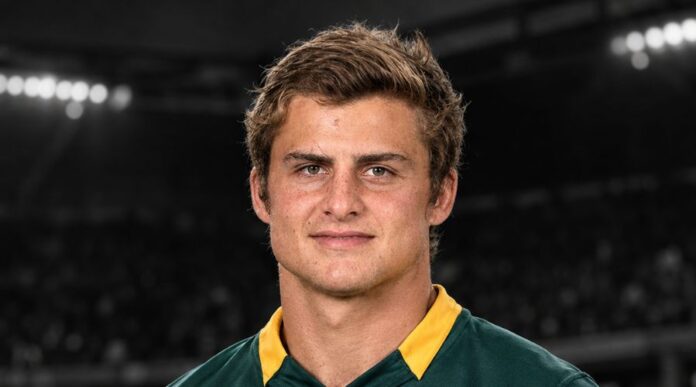
There is a photograph that stops you cold.
Pat Lambie, mid-roar, fist clenched, green jersey blazing under the Kings Park floodlights. October 8, 2016. South Africa versus New Zealand. The Rugby Championship. He looks like a man at the height of his powers — and in a sense, he was.
But what the image doesn’t show is what had already happened to him just four months earlier at Newlands, when Ireland’s CJ Stander came through late and high on a charge-down attempt and put Lambie flat on the turf. Red card. Stretcher. The beginning of the end.
That roar in the photograph? He was already fighting a battle nobody in the stadium could see.
Pat Lambie carried a quote. He shared it publicly and it circulated widely enough to become associated with him in the way that certain phrases attach themselves to certain people — not because they invented the words, but because they lived them so completely that the words became theirs. The quote is this:
“The most important thing you will ever wear is your attitude.”
It is the kind of line that can slide past you if you encounter it without context. Motivational. Neat. Easy to repost, easy to scroll past. But set it against the actual arc of Patrick Jonathan Lambie’s life in rugby, and it stops being a poster quote entirely.
It becomes something harder to look at.
Lambie was not supposed to be the story at Michaelhouse. He was not a prodigious talent as a younger schoolboy — he came into his own at the KwaZulu-Natal Midlands boarding school, not before it. By the time he left in 2008, he was head boy, cricket captain, rugby captain, and a two-time SA Schools selection. In 2010, he became Michaelhouse’s first Springbok rugby player in the school’s 115-year history.
The school’s founding rector wrote that a man’s moral and spiritual tone “is largely determined for life by his school.” Pat Lambie is probably the most complete example of what Michaelhouse intended to produce: composed, principled, a leader by example rather than volume. Those qualities followed him everywhere.
When John Smit was Springbok captain, he offered a character assessment of a young Pat Lambie freshly selected to the national team: “He is the guy every father hopes will knock on the door to take out his daughter.” That is not a rugby compliment. That is something rarer — a statement about who someone actually is.
On the field, the rugby was extraordinary. He made his Test debut on 6 November 2010 against Ireland, converting a try after replacing Morné Steyn in a 23–21 victory. He went on to appear in two Rugby World Cups, earn 56 Test caps, and set a Sharks record for most points scored in a single Super Rugby season. A prop of the calibre of Jannie du Plessis likened Pat Lambie to the Rudyard Kipling poem “If” — the one about keeping your head when all around you are losing theirs.
Calm. Composed. Attitude, worn visibly, every single week.
Then the injuries started. A torn bicep. A neck vertebra. And then Newlands, June 2016. CJ Stander. The collision that changed everything.
✍️ JAY | JPS SAYS: “What strikes me about Pat Lambie is that the attitude was never performance. It wasn’t manufactured for cameras or press conferences. It was just who he was — and that’s exactly what made watching his career unravel so difficult. You couldn’t point to a character flaw, a bad decision, a moment of weakness. The game simply broke a good man, and he handled even that with grace.”
It was that collision against Ireland in 2016 that would ultimately prove to be the beginning of the end for Lambie as a rugby player. But he didn’t stop. He returned to the Springbok squad later that year, was still fighting for his Test place — hence that photograph at Kings Park in October, four months on from Newlands. He played his final Test against Wales in November 2016. Then he moved to France, signed for Racing 92, and tried again.
He tried everything. Rest, medication, neck treatment, jaw treatment, eye rehabilitation, multivitamins. He played through a concussion in Racing’s Champions Cup semifinal against Munster in April 2018, describing the moment honestly: “I stayed at the bottom of the ruck, feeling dizzy, everything was spinning, tried to get up, sort of wobbled a bit… I tried to pretend that I was fine. I was trying to lie to myself.”
He played in the final against Leinster in Bilbao. Limped off early with a knee injury. The concussion symptoms that followed were the worst yet — trembling legs, pounding headaches, migraines, eye irritations. Two neurologists in two countries said the same thing: stop.
On 18 January 2019, Pat Lambie announced his retirement from all rugby at the age of 28. “I am bitterly disappointed and sad because I still have some dreams on the rugby field, and I feel like some good playing days are ahead of me,” he said. Then, in the same breath: relief. Relief that the risk was over. Relief that whatever came next, at least his brain would be safe.
He was 28. He could, as he later said, essentially have been entering his prime.
The grief didn’t disappear cleanly. Pat Lambie admitted years later that it was difficult, that there was resentment and a lot of what-ifs. He watched friends the same age still running out on fields he would never run on again. That is an honest thing to say, and it matters that he said it — because it would have been easy to perform acceptance, to give the gracious-retirement speech and move on. He didn’t pretend the loss wasn’t real.
But he also didn’t stop. With the same commitment, passion and fearlessness he showed on the rugby field, Lambie approached life after rugby — returning to KwaZulu-Natal, building a career in property development, raising a family on the North Coast. A man who studied environmental management part-time during his playing days because he understood that careers end and character is what remains.
And that, finally, is where the quote lands.
It is easy to wear your attitude when everything is going your way. When you are 20 years old and handing off Schalk Burger in a Currie Cup final and the whole of South African rugby is opening up in front of you.
The test of that philosophy is not those moments. The test is the floor of a ruck in France, dizzy and spinning, knowing that if you raise your hand your season is probably over — and choosing wrong in that moment, and then choosing right in the bigger one that followed.
The test is waking up with a headache that feels like a baseball bat every single morning and still building something.
Pat Lambie did not coin that quote. But he earned it in a way that very few people could claim. The jersey was taken from him. The attitude never was.