


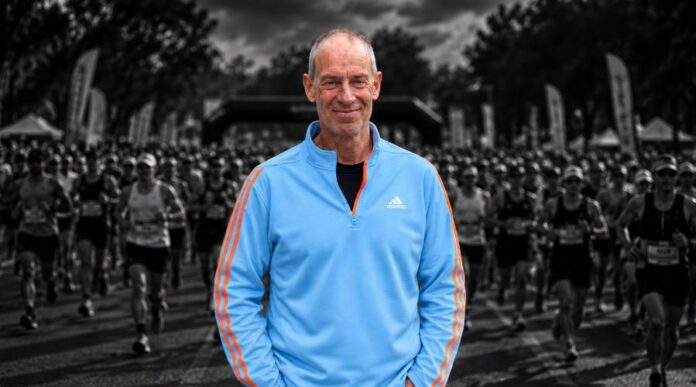
Paul Sinton-Hewitt started parkrun with 13 runners and five volunteers on Saturday 2 October 2004, and on 13 June 2026 the free weekly timed 5km event he invented staged its one millionth edition. He was 44 at that first run, recently fired, his marriage under strain and carrying an injury that had stopped him training with his club. The shape he gave the thing — timed, free, open to anybody, every Saturday, with everyone staying for coffee afterwards — he took from the grassroots running culture he grew up in as a schoolboy in South Africa.
That makes the biggest participation movement in world running a South African story as much as a British one. parkrun now runs at more than 2,800 event locations in 23 countries, with over 12 million registrations banked. South Africa is one of the largest communities outside the UK.
The Boy Who Found Running At Potchefstroom High School For Boys
Sinton-Hewitt was born on 12 August 1960 in Southern Rhodesia, now Zimbabwe, while his mother was briefly out of South Africa. His father was born in Australia to British parents, emigrated to South Africa and was working as a photographer when the two met. At five, with his parents’ marriage failing, Sinton-Hewitt and his older brother and sister became wards of the state and were raised in boarding schools and institutional care. He has described a childhood marked by bullying, and he found running at about 11 as the thing that gave him freedom and steadied his moods.
He boarded at Potchefstroom High School for Boys from 1973 to 1977, and the school lists him among its notable sports alumni. He has said he was unhappy there, mostly because of what was happening at home, and that teachers and other boys carried him through it. What he remembers of the place is early-morning runs and sneaking out for fish and chips.
Why Paul Sinton-Hewitt Started parkrun At 44
After school he took a university stipend and dropped out inside a couple of terms over money, then served two years of national service in the Air Force division of the South African Defence Force, where he trained as a radar instructor during the Angolan conflict. He turned that systems grounding into a career, moving into the new IT industry in Johannesburg as a self-taught programmer and working on software for early ATM systems.
He moved to the United Kingdom, worked in IT and consultancy and joined the club running scene with Ranelagh Harriers and The Stragglers. He has spoken openly about depression across his life, including a breakdown in 1995.
By 2004 the job was gone, the marriage was in trouble and an injury had cut him off from the club that was his social life. What he put on instead, on 2 October that year, was the Bushy Park Time Trial: a 5km course, a stopwatch, 13 runners and five volunteers, one of them his wife Joanne. The condition was that everybody stayed afterwards for coffee.
A second event at Wimbledon followed in 2007 and proved the model could be copied anywhere. The name became parkrun around 2008, and the first junior parkrun, 2km for ages four to 14, was added in April 2010. The first event outside the UK was the Rolf Valley Time Trial in Harare, which later closed in Zimbabwe’s political turmoil, and Denmark followed in 2009.
Who Brought parkrun To South Africa?
Bruce Fordyce. The nine-time Comrades Marathon winner, a long-time acquaintance of Sinton-Hewitt’s, visited the original event in April 2011, was talked into running it, and went home convinced the model belonged in South Africa. The first official South African parkrun was staged at Delta Park in Johannesburg in November 2011, on the 12th, and Fordyce, now president of parkrun South Africa, has said he could never have guessed that the 29 people at that inaugural Delta Park event would become more than a million South Africans inside 13 years. The millionth person to run, walk or volunteer at a South African parkrun was counted on Saturday 16 November 2024.
The South African ledger:
- First event: Delta Park, Johannesburg, 12 November 2011, 29 people
- Events staged in 2011, the first full year: eight
- Events now: more than 220, spread across every province, 64 of them in Gauteng
- Registrations: more than 1.7 million
- Finishes recorded: more than 13.4 million
- Volunteers: more than 60 000
- Global milestone banked locally: the 10 millionth parkrun barcode registration happened in South Africa
The movement has also pushed well past running. More than 2,200 GP surgeries are twinned with a local parkrun through the parkrun practice social prescribing programme, and more than 2,000 primary schools have signed up to parkrun primary since it launched in September 2025.
The Honours, The Book And The Walking
Sinton-Hewitt was made a Commander of the Order of the British Empire in the 2014 Birthday Honours for services to grassroots sport participation. He became an Ashoka Fellow in 2016 and received the Royal Society of Arts Albert Medal in December 2019. Loughborough University made him a Doctor of the University at its winter graduation on 12 December 2025 for his contribution to sport, health and wellbeing. Runner’s World has named him a Hero of Running.
His memoir, One Small Step: The Incredible Story of parkrun, written with Matt Whyman, was published in April 2025 and became a Sunday Times bestseller.
He still turns up every week. His parkrun personal best is 18:22, he has completed more than 600 parkruns at hundreds of different locations, and he is a member of both the 500 Club and the Volunteer 100 Club. Knee arthritis means most of his recent appearances are walks or volunteer shifts rather than runs.
He went back to Potchefstroom in November 2017 for his 40th matric reunion on the 11th, his first visit to the school in four decades, and the Potchefstroom Herald reported that he ran a special Freedom parkrun on the registered course the next day at Trimpark parkrun. Trimpark has since closed and the town’s event is now Kleinplaas parkrun. The same trip took him to Delta Park to cut parkrun South Africa’s sixth birthday cake with Fordyce.
At the one millionth event he stood with Olympic 800m and 1500m champion Dame Kelly Holmes and parkrun Global chief executive Elizabeth Duggan, and said that people born since 2004 have never known a world without parkrun. In January 2026 the King watched Sandringham parkrun as a spectator. Duggan has set the next target at growing parkrun from 23 countries to 30 by 2030.