

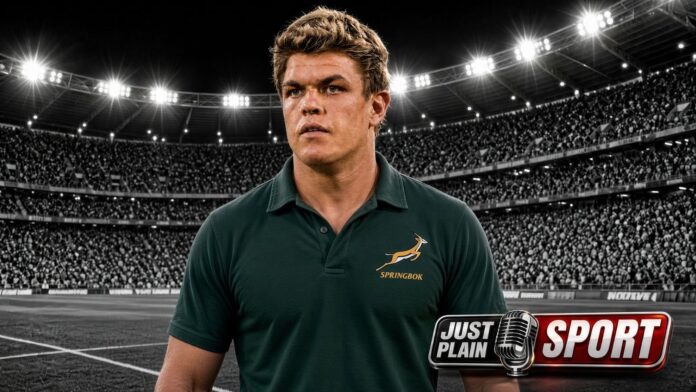
Birthday Tribute | Juan Smith | 30 July 2026 | Cheetahs · Toulon · Springboks · Rugby
There are flankers who play the position with craft and guile. And then there are those who play it like a threat to public safety. Juan Smith belonged firmly in the second category. Born on 30 July 1981, in Bloemfontein, he turns 45 today.
BLOEMFONTEIN, JBM HERTZOG AND A NAME BUILT FOR THE No 7 JERSEY
Juanne Hugo Smith grew up in Bloemfontein, the Free State capital that has produced more than its share of hard, uncomplicated rugby forwards. He attended JBM Hertzog High School, where his size and appetite for contact marked him early as a loose forward rather than anything requiring finesse.
The Free State system in the late 1990s was built around exactly the kind of player Smith was becoming: a ball-carrier who did not look for space so much as remove whatever occupied it. By the time he left school, the Cheetahs had already identified him as a project worth developing.
In 2002 he signed with the Cheetahs and, in the same year, played a central role in South Africa’s Under-21 side winning the IRB Under-21 Rugby World Cup on home soil. The tournament confirmed what Free State coaches had suspected — Juan Smith was not a promising age-group player marking time. He was ready.
THE EARLY CAREER: BLOEMFONTEIN’S BRUISER FINDS HIS FEET
Juan Smith made his senior debut for the Cheetahs in the 2002 Currie Cup, and by 2003 — barely a year later — he was in a Springbok jersey. He made his international debut for South Africa on 7 June 2003 as a reserve in a 29–25 victory over Scotland at Kings Park Stadium in Durban, then held his place for the second Test against the Scots the following week.
His rise from there was immediate. He started at number eight during the 2003 Tri Nations series against Australia and New Zealand, and was included in the Springbok squad for the 2003 Rugby World Cup in Australia, where he played four matches and scored a try against Samoa. A teenager two years earlier, he was now a Test-capped forward at the game’s biggest tournament.
He spent close to a decade at his home franchise, staying with the Cheetahs from 2002 to 2011, and helped them win Currie Cup gold in 2005 — even as Springbok call-ups regularly pulled him away from Bloemfontein.
THE ACHILLES: A CAREER TAKEN APART, PIECE BY PIECE
On 25 February 2011, playing for the Cheetahs against the Bulls in Bloemfontein, Smith tore his Achilles tendon, an injury that ended his season and cost him the 2011 Rugby Championship and World Cup. It was the start of a period that had nothing to do with rugby’s usual language of comebacks and everything to do with survival.
By April 2012, after four operations that had failed to fully resolve the injury, Juan Smith announced an indefinite break from the game, saying the right course was to let the injury heal completely. A fifth operation followed after surgeons acknowledged the first two procedures had been botched, and Smith later described the pain during that period as severe enough that he was often reluctant to move the leg at all. A comeback attempt for the Cheetahs against the Bulls in February 2013 ended in a fresh MRI scan and a formal retirement announcement.
He described the 28 months away from the game as the darkest period of his life. Rugby had written him off. He had all but written himself off too.
THE BREAKTHROUGH: TOULON’S GAMBLE PAYS OFF
Seven months after retiring, on 10 September 2013, Juan Smith signed with French club RC Toulonnais, persuaded back into the sport by coach Bernard Laporte. He made his Toulon debut as a substitute against Grenoble that September — his first competitive rugby in over two years.
What followed startled a sport that had already filed his career under “finished.” Toulon won the Heineken Cup in Smith’s comeback season, becoming one of the standout stories of that European campaign. His former teammate Jonny Wilkinson described him afterwards as a player who simply did not stop — running the ball up, standing up, and doing it again, with no drop-off across eighty minutes.
THE PINNACLE: A WORLD CUP, A LIONS SERIES, AND ONE LAST CAP
Smith’s defining rugby achievement came earlier, in 2007, when he was part of Jake White’s Springbok squad that won the Rugby World Cup in France. He was regarded as one of the most complete loose forwards of his generation, built on ball-carrying power, relentless work-rate and a refusal to give ground in defence.
Two years later came a rarer distinction. In 2009 Juan Smith played all three Springbok Tests against the British and Irish Lions as South Africa won the series 2-1, a series many South African players and fans rate above a World Cup for its intensity and scarcity.
The final chapter of his international career came against everything doctors had predicted. Recalled to the Springbok squad in August 2014 after an 18-month absence from Test rugby, Smith started against Argentina in Salta on 23 August 2014, earning his 70th and final cap — a comeback built entirely on a joint that had been operated on five times.
FROM FLANKER TO FARMER
Even during the darkest stretch of his injury recovery, Juan Smith worked on a livestock farm outside Bloemfontein that had belonged to his late father. After a further spell with Toyota Verblitz in Japan, he retired from all rugby in 2017, citing family reasons.
Since retiring, Smith has moved back to South Africa, where he now runs a butchery and a farm in the Free State. In 2021 he was inducted into the RugbyPass Hall of Fame, formal recognition of a career that included a World Cup, a Lions series win, and a second act nobody had scripted for him.
Happy 45th Birthday, Juan. From all of us at Just Plain Sport — you turned five surgeries and a written-off career into a Heineken Cup medal and a 70th Test cap; that is not a comeback story, it is a refusal. 🎂🏉