

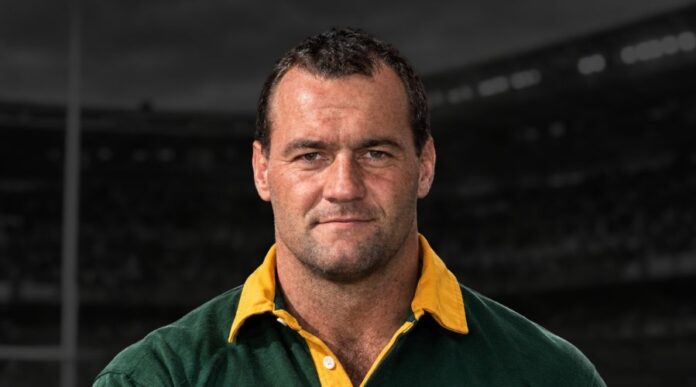
Birthday Tribute – Ruben Kruger | Blue Bulls · Springboks · Rugby
Ruben Kruger would have turned 56 this year, on 30 March — thirty-one years after the 1995 Rugby World Cup he won. Sixteen years after his death, this is a tribute to the parts of his story the highlight reels never showed.
RUBEN KRUGER: A FARM BOY FROM VREDE WHO NEVER RAISED HIS VOICE
Ruben Kruger was born on 30 March 1970 in Vrede, in the northeastern Free State, and grew up on Kalkkrans, the farm of his parents Baan and Cecilia, before Grey College in Bloemfontein got hold of him. He arrived in standard 8 and was already in the first team. He made SA Schools in 1987 and 1988, and captained the 1988 side.
That Grey first XV is still spoken of as one of the great school teams — it produced five Springboks: Kruger, Charl Marais, Naka Drotské, Pieter Muller and Heinrich Fuls. In 1987 the eighth man and captain of Grey was Hansie Cronjé. Naka had already been Ruben’s flank partner from Eastern Free State primary Craven Week.
Former Grey principal Johan Volsteedt later called him “a man among men.” His head coach at the school, Dries van der Wal, remembered a balance and anticipation that went beyond rugby. Those who knew him described a boerseun who did everything by the book and without complaint. He worked hard, loved the game, and never wanted the attention that came with being good at it. He and Lize started dating at school.
THE FLANKER WHO LET HIS BOOTS DO THE TALKING
Ruben Kruger made his provincial debut for Free State in 1991, moved to Northern Transvaal in 1993, and stayed there — through its transformation into the Blue Bulls — for the rest of his career. He won his first Test cap against Argentina on 6 November 1993 in Buenos Aires. Springbok number 596. He was on the winning side in his first 14 Tests.
It was Springbok coach Kitch Christie, building toward the 1995 World Cup, who gave him the nickname that outlived him: the Silent Assassin. Kruger barely spoke in interviews and never chased a headline. He let the collisions do it instead.
In the lean late-90s years at Loftus, with the circle waiting for a speech, teammates remember him turning to Jacques Olivier and saying only that the two of them would play their hearts out — what everyone else did was up to them.
“Some Boks won World Cups and made sure you knew about it. Ruben Kruger won one and went home to milk the attention out of nobody — that’s a different kind of tough!” – 🎙Jay
1995: THE SILENCE THAT WON A WORLD CUP
The Silent Assassin’s defining month came in the 1995 Rugby World Cup. He started five matches. Against Western Samoa in the quarter-final he tackled until his arm was so sore he could not lift it above his shoulder. He started the semi-final anyway.
That semi-final against France was played in a Kings Park downpour so heavy the match was nearly abandoned. He scored the try that helped send South Africa through to the final.
At Ellis Park a week later, in the first half against the All Blacks, he went over from a pick-and-go. Referee Ed Morrison ruled the ball held up. No try was given in that final. Twenty years on, Morrison said Kruger probably did score. “Nobody said anything, because they won.” Kruger went back to the next ruck. Joel Stransky’s drop goal won it 15-12 in extra time. When Francois Pienaar lifted the Webb Ellis Cup with Nelson Mandela beside him, Kruger stood in the background, exactly where he’d spent the whole tournament.
Ruben Kruger was named South African Rugby Player of the Year that same year.
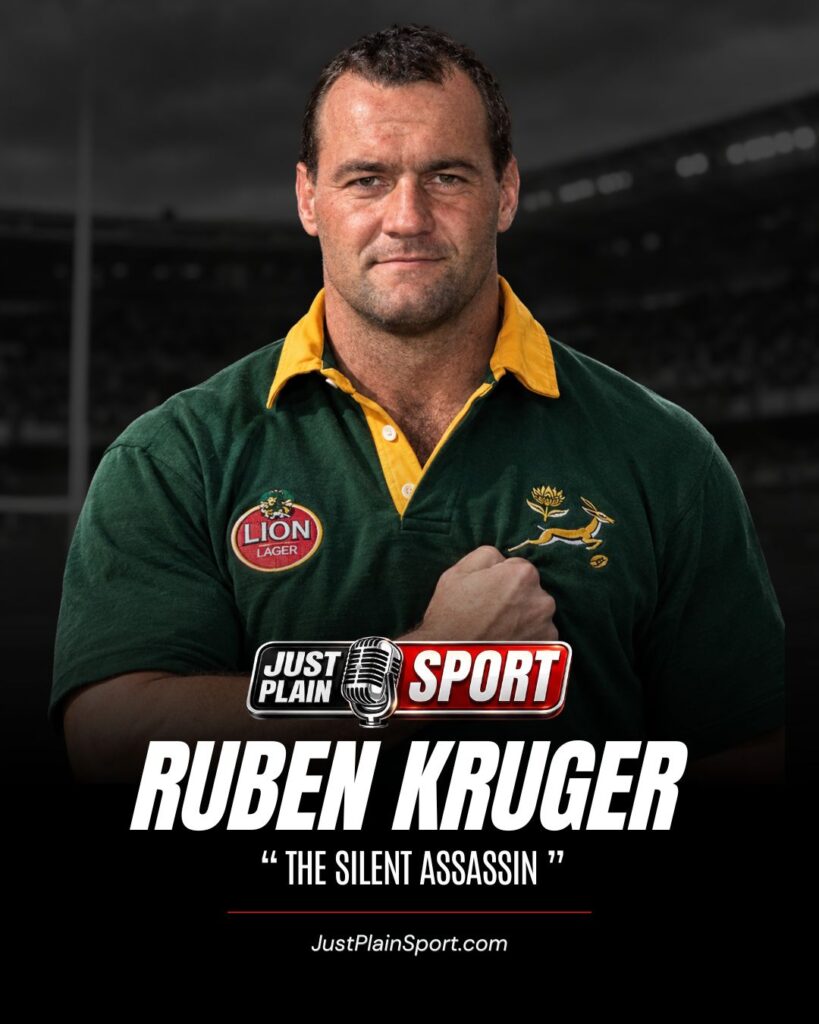
A broken leg in the mid-90s Tri-Nations years would have finished a lesser career. Kruger fought back into the 1999 World Cup squad, even after the starting seven jersey had gone to Rassie Erasmus and André Venter. His last Test was the third-place play-off against New Zealand in Cardiff on 4 November 1999. In 1998 he was part of the Blue Bulls side that won the Currie Cup.
His record, 1993 to 1999:
- 36 Tests, 7 tries, 35 points — Springbok no. 596
- 20 tour matches (56 Springbok games in all)
- Two World Cups played — 1995 winners, 1999
- 96 appearances for Northern Transvaal/Blue Bulls (1993-2000), 135 points
- 10 Super Rugby appearances for the Bulls (1996-2000)
TEN YEARS, ONE DIAGNOSIS, AND A FAITH THAT DIDN’T WAVER
The headaches he treated like the broken leg — as inconvenience — until he blacked out during a match at Loftus in 2000. A brain tumour. Career over at 30. What followed was a decade of operations, remission, and recurrence, fought largely out of public view.
Faith mattered to Kruger and his family through that decade. In early 2009, surgeons reportedly operated for five hours, removing an estimated 90 percent of a tumour later described as “the size of a man’s fist.” Later that year, during a family road trip after a Test, Kruger lost consciousness at the wheel. His wife, Lize, reached over and steered the car to safety. The family walked away. Doctors told them the cancer was terminal not long after.
Ruben and Lize spent six months preparing their daughters, then seven and four, for what was coming. Family accounts describe him waking from a deep sleep shortly before the end and telling Lize only that he had dreamed something “big, big, big.” He died on 27 January 2010, two months short of his 40th birthday.
The Pretoria farewell filled a church with Springboks. André Venter was pushed in by wheelchair. He had visited that December. “He prayed for me in spite of all his pain,” Venter said. “Ruben, when I get to heaven one day, I want to be in the same team as you again.” Lize told the congregation they were proud of him not because he was a Springbok rugby player, but because he was a Springbok dad — and that in his life he never said anything bad to or about her. Zoë and Isabella wrote: “Thank you that we could lie in your arms every morning and ride with you in the bakkie every day.”
The next day they buried him on the farm outside Vrede where the story began.
FROM SILENT ASSASSIN TO GENTLE GIANT
After rugby, Ruben Kruger opened a Minolta camera franchise in Pretoria and ran it like anyone else would — no interviews, no memoir, no cashing in on the jersey. Grant Roberts played him in the 2009 film Invictus, but Kruger skipped the premiere’s celebration dinner. His seven-year-old daughter Zoë was sick that night, and Sports Illustrated later reported his reasoning: it’s the character you show that matters, not the trophies.
That belief outlived him. Years later, when young Zoë faced an opponent on a tennis court who had no proper shoes, she gave the girl her own spare pair. “Now we can have a fair match,” she told her.
The No. 7 hook in the Grey dressing room still carries his name. His nephew Henco Venter — sister Marietjie’s son — later sat in that same corner and wore the same school jersey. Christmas visits, Blue Bulls jerseys in the backyard, a signed 1995 ball still in the family home. The quiet kept travelling.
THE DAUGHTERS CARRYING HIS FIGHT ONTO A TENNIS COURT
Ruben Kruger’s wife, Lize, is the sister of South African tennis coach Frans Cronjé, and it was Cronjé who put a racket in his nieces’ hands. Zoë, born in 2002, started out hitting balls against a net her family chalked onto her grandmother’s garage wall in Pretoria. She was ranked No. 1 in South Africa’s under-12s by age nine.
Isabella, born in 2005, developed a harder-hitting game of her own. Both sisters moved to Florida’s IMG Academy in 2014 and later trained together under coach Anthony Harris in Cape Town. Their results since:
- Zoë won her first professional title in October 2021, beating Dutch fifth seed Suzan Lamens, and reached a career-high ranking of 424 in April 2022
- Isabella reached the girls’ singles quarter-final at Wimbledon in 2022, was ranked South Africa’s top female player in February 2024, and made her Billie Jean King Cup debut for the country in 2023
- Isabella joined the NCAA program at Auburn University in 2025
Zoë has said she pursues a pre-med degree in genetics because of her father’s illness, and that his memory still carries her through matches she doesn’t think she can win. “I have what it takes,” she has said, “because he had what it took.”
From all of us at Just Plain Sport — the Silent Assassin never needed the spotlight in life, and sixteen years on, two young South African women are proving his quiet was never empty. 🎂🏉