


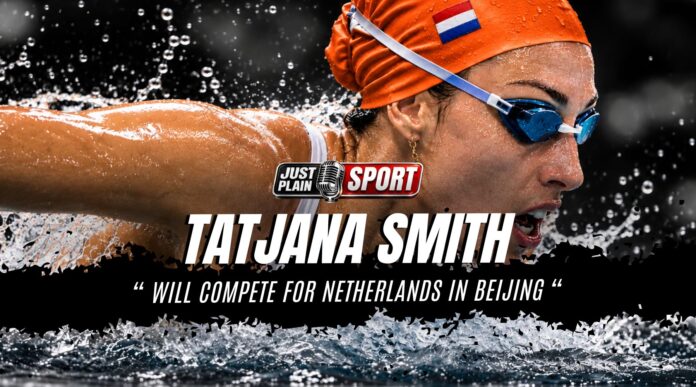
Tatjana Smith has switched her sporting nationality to the Netherlands with immediate effect, World Aquatics has confirmed. The two-time Olympic champion notified Swimming South Africa and the Dutch federation, KNZB, on 10 November 2026. She will make her debut in Dutch colours at the World Short Course Championships in Beijing in December.
She is leaving a federation whose president and chief executive are provisionally suspended by World Aquatics’ Aquatics Integrity Unit. She is also leaving a system in which athletes are asked to pay for their own place on the national team.
A federation under investigation
On 24 August 2026 the Aquatics Integrity Unit provisionally suspended Swimming South Africa president Alan Fritz and chief executive Shaun Adriaanse. The allegations under the World Aquatics Integrity Code include abuse of power and the provision of false information and fake documents. The proceedings are ongoing, and no final findings have been published. Smith’s move came while both cases remain open.
The prize money that was held, then treated as a fee
Smith’s most public dispute concerned money she had already earned. Her 2023 World Championships prize money totalled $35,000, and the federation held the principal for more than a year. Its stated reason was that she had competed in her personal sponsor’s kit, Speedo, rather than the federation’s sponsor, Arena.
The principal was paid around the time of the Paris 2024 Olympics. The interest was not. A letter of demand dated 25 August 2026 from Smith’s attorneys alleges that operations manager Mafata Modutoane described keeping that interest as a “management fee”. The federation later agreed to pay the full interest.
On 13 October 2026, at a parliamentary portfolio committee hearing, acting president Zikie Molusi apologised for how the matter was handled. He said it should never have happened. An apology that arrives after legal letters, and while the federation’s leadership is under integrity investigation, is not a reform.
The larger problem: no state safety net
The prize-money episode sits inside a wider pattern. Direct government support for individual elite athletes in South Africa is limited, and funding flows mainly to federations and provincial structures. The top tier of SASCOC’s Operation Excellence programme has been reported at up to R300,000 a year, and only a small number of athletes qualify. Most do not receive anything close to a living stipend.
Smith has said it plainly. In a November 2026 interview she said: “In South Africa, athletes are not financially supported by the state. You have to bring in your own sponsors. Not winning meant you had no income.” She has described relying on her parents until after her Tokyo success, and has estimated that her family invested roughly R10 million across her career. Sponsorship arrived on performance terms, so missing the top of the podium meant the income stopped.
Athletes told to pay before they can wear the national colours
A circular dated 28 October 2026, issued under acting president Zikie Molusi, required athletes selected for the Beijing squad to pay up to roughly R55,000 each, excluding visas, or face withdrawal. It came with a payment schedule.
Swimming South Africa’s own figures show where the money came from. Its 2025 high-performance expenditure was R15.44 million. Athletes contributed R9.53 million of that, and the federation and its partners contributed R5.91 million. New grant income from the Department of Sport, Arts and Culture was around R3.1 million in the recent year referenced.
This is not unique to swimming. Other codes have faced similar shortfalls, with national teams describing having to fund their own flights, accommodation and camps, and government intervening only after public pressure. The Minister of Sport, Arts and Culture has said that athletes who have earned selection should not have to fund major international participation personally. In practice, many still do.
“South African athletes in all sports are not looked after by their country, but to tell your most decorated Olympian she needs to pay money before she can be picked for the team is absolutely disgusting!” – 🎙️Jay
Why the switch happened now
Smith has spoken about the cumulative weight: the absence of state support, sponsorship tied to results, the personal financial load carried by her family, and a federation environment she has described as not putting athletes first. The prize-money dispute and the interest-as-fee allegation were the most visible flashpoints. The suspensions, the parliamentary apology and the payment circular supply the rest of the context.
She holds dual South African and Dutch citizenship and will remain based in South Africa. She will race in Beijing in December as a Dutch athlete.
The facts on the table are these. A two-time Olympic champion left after her prize money was held and its interest was treated as a management fee. She left while the federation’s top two officials were provisionally suspended on integrity grounds. And she left a system in which athletes are asked to pay tens of thousands of rand, or face withdrawal, to represent South Africa on the world stage.