

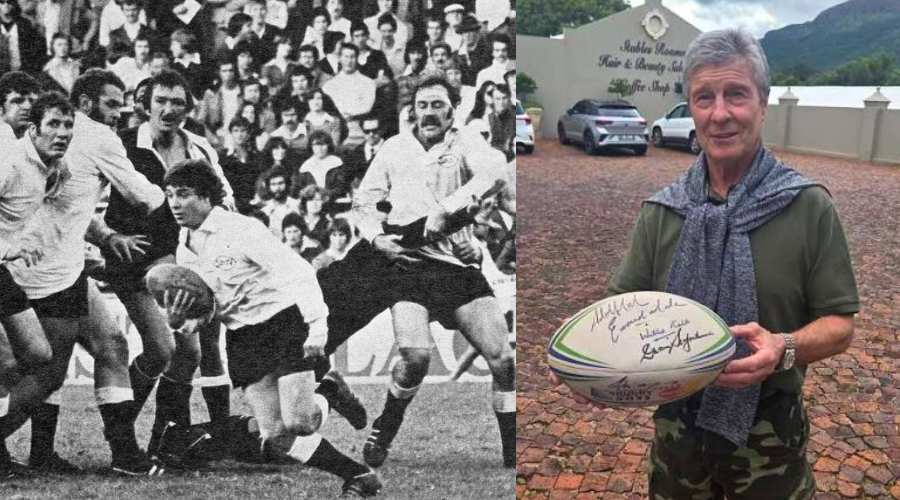
Birthday Tribute | Divan Serfontein | 3 August 2026 | Western Province · Springboks · Rugby
There are Springbok scrumhalves who built an entire identity around the number nine jersey. And then there are the ones who wore it for four seasons, captained a dynasty, survived rugby’s most hostile tour, and swapped it for a surgeon’s theatre before they turned 31. Divan Serfontein belongs firmly in the second category. Born on 3 August 1954, in Krugersdorp, he turns 72 today.
FROM THE WEST RAND TO THE VAAL, BY WAY OF STELLENBOSCH
Serfontein, full name David Jacobus Serfontein, grew up on the West Rand and went to school at Vanderbijlpark High School in the old Transvaal, a region better known for producing steel than scrumhalves. At 1.67 metres and 70 kilograms, he was never built like the forwards around him, and he never tried to compensate for it. His game was built on finding space other players couldn’t see.
He enrolled at Stellenbosch University in 1974 and joined the Maties, starting out in the club’s under-20 side. In his first match for the Western Province under-20 team, he lined up alongside a teenage Peter Kirsten, later a Test cricketer for South Africa, proof that the Cape’s sporting production line ran through more than one code.
1976: A FIRST-TEAM DEBUT AGAINST THE ALL BLACKS, NOT A LEAGUE FIXTURE
Divan Serfontein’s Western Province first-team debut came in 1976, and it was not a gentle introduction. He was picked to face Andy Leslie’s touring All Blacks, and Western Province won 12-11. There was no Currie Cup fixture to ease him in. His first taste of senior provincial rugby was beating New Zealand. He spent the rest of the decade cementing himself as the union’s first-choice scrumhalf.
A SPRINGBOK CAREER PLAYED BEHIND A CLOSED DOOR
Every one of Divan Serfontein’s 19 Test caps came inside South African rugby’s isolation years. The Rugby World Cup did not exist yet — it would not be played until 1987, three years after he retired, and South Africa would remain excluded from it until 1995. His entire international career was confined to whichever nations were still willing to tour: the British and Irish Lions, France, Ireland, New Zealand, the United States, and South America’s Jaguars. There was no global tournament waiting for Divan Serfontein to prove himself on. There was only whoever showed up that year.
31 MAY 1980, NEWLANDS: THE TRY THAT ANNOUNCED HIM
Divan Serfontein made his Test debut on 31 May 1980 against the touring British and Irish Lions at Newlands, wearing Springbok No. 508, and he did not wait long to make his mark. Eleven minutes in, he snatched a loose ball and sprinted 40 metres to score the opening try, setting the tone for a 26-22 Springbok win.
That same series saw a young flyhalf named Naas Botha establish himself alongside him, and the two would go on to form the Springboks’ first-choice halfback pairing for the rest of Serfontein’s career. Captain Morné du Plessis later said having Botha and Serfontein both in their prime gave that Lions-series team its cohesion. Serfontein played all four Tests of the series, which South Africa won 3-1, before touring South America with the Jaguars later that year and facing France at Loftus Versfeld in November.
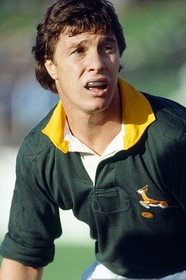
CAPTAIN OF A DYNASTY, SURVIVOR OF THE BARBED WIRE TOUR
Divan Serfontein was appointed Western Province captain at the start of the 1981 season, on his 50th appearance for the union. That same year he toured New Zealand with the Springbok side that became known as the Barbed Wire Boks, named for the fencing strung around grounds like Whangarei’s Okara Park to hold back protesters opposing apartheid South Africa’s presence in the country.
The tour party included Errol Tobias, the first non-white player ever selected for the Springboks. The Hamilton fixture against Waikato was cancelled outright after demonstrators invaded the pitch, and the third Test at Eden Park was disrupted by a light aircraft dropping flour bombs onto the field mid-match. Serfontein played in all three Tests against the All Blacks on that tour, winning one and losing two. Off the field, he and Springbok wing Ray Mordt set off stink bombs in team doctor Augie Cohen’s hotel room as a prank that spiralled out of control, drawing police and a bomb squad to the hotel and nearly getting the pair sent home.
Back in South Africa, Serfontein’s leadership translated into silverware. He captained Western Province to three straight Currie Cup titles from 1982 to 1984, the opening stretch of a run that would eventually reach five in a row for the union, and he was named South African Rugby Player of the Year for 1982.
In October 1984, in what became his final Test series, he was handed the Springbok captaincy for both matches against the touring South American Jaguars, becoming the 39th man to lead the Springboks in a Test match — and handing the captaincy on to his old halfback partner Naas Botha when he retired. He played 100 matches for Western Province across nine seasons, and his final appearance for the union was a fitting one, a 19-9 win over the Sharks at Newlands. He finished his Test career with 19 consecutive caps and three tries, never having lost his starting place.
FROM SCRUMHALF TO SURGEON
Serfontein retired from rugby at 30, at the peak of his playing powers, to complete his path to becoming an orthopaedic surgeon. He stayed close to the game as a medical voice rather than a coaching one. In 2000, working as a doctor with the Stormers, he publicly questioned whether Bobby Skinstad’s knee rehabilitation had been rushed ahead of a World Cup campaign.
In 2016, he spoke out publicly against what he called incompetence in Western Province Rugby’s administration during a financial and governance crisis at the union. He was later appointed to the board of Namibian Rugby Ltd and became a brand ambassador for Namibian Breweries.
His playing legacy has outlasted his playing days. News24 rated him among the nine greatest Springbok scrumhalves in the position’s history, and rugby365 selected him at number nine in their all-time Currie Cup XV, citing his alertness, pace, and leadership during Western Province’s five-in-a-row era.
Happy 72nd Birthday, Divan Serfontein. From all of us at Just Plain Sport — you captained a dynasty, survived rugby’s ugliest tour, and still chose to spend the rest of your life fixing other people’s bones.
📸 Images via SA Rugby