

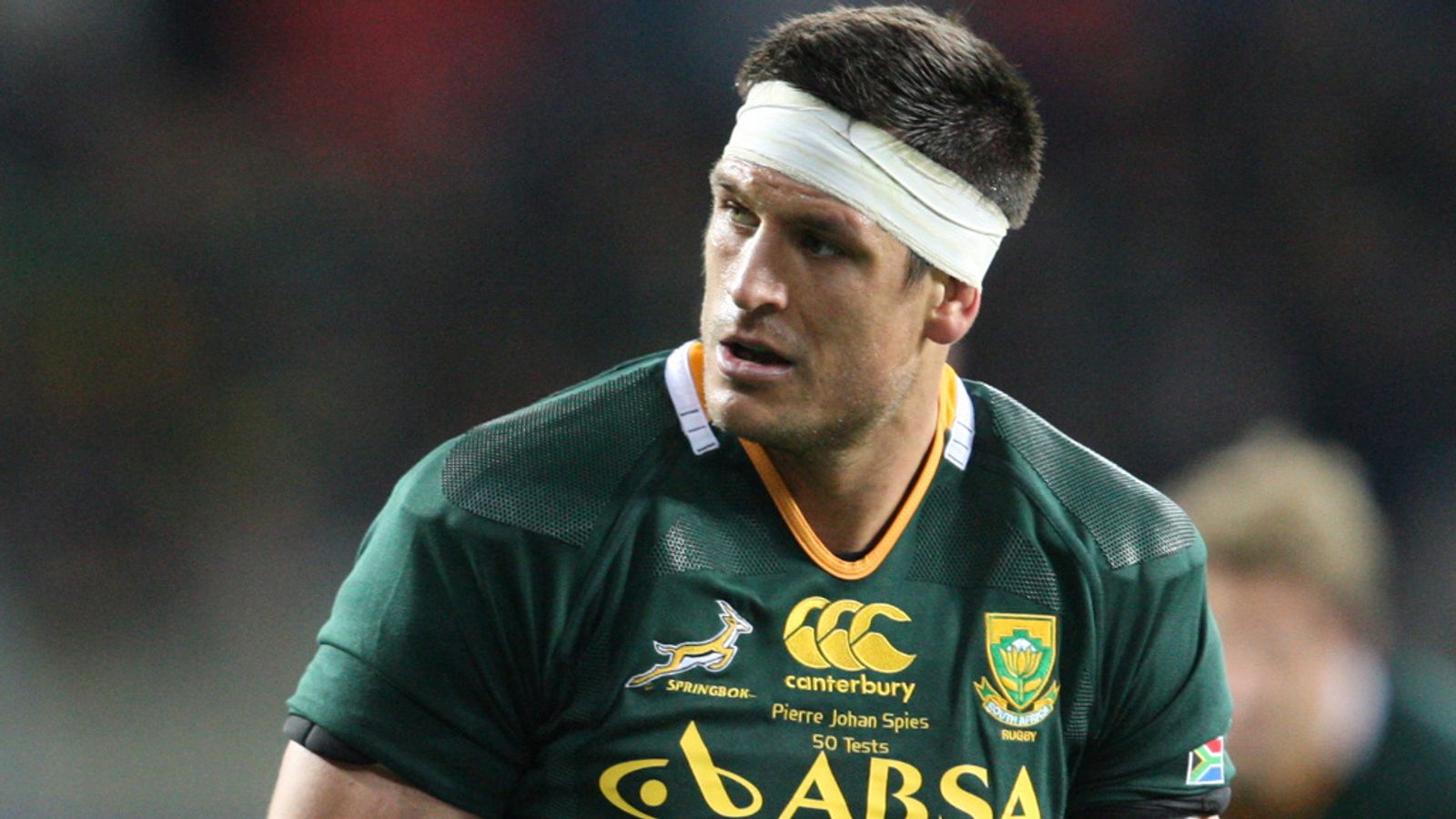
There are rugby players who make their living in the hard yards, who do the grinding work that never makes the highlight reel. And then there are those who change the nature of the game itself simply by being on the field — players whose physical presence and raw athleticism make the impossible routine. Pierre Spies belongs firmly in the second category. Born on this very day, 8 June 1985, in Pretoria, he turns 41 today. And what a journey it has been.
Happy Birthday, Pierre. You gave South African rugby a forward it had never quite seen before, and you carried that gift with grace.
ROOTS: THE SON OF PRETORIA
Pierre Johan Spies grew up in Pretoria, in a home that was shaped as much by calling as by sport. His father, Pierre Spies Snr, had worn the Northern Transvaal jersey as a wing in the 1970s, and the rugby bloodline was real. But the household Pierre grew up in was one of faith first — both his parents were committed to full-time Christian ministry, and the values that shaped him were laid down long before he ever pulled on a rugby boot.
He has been clear, in the years since, that the foundation his parents built was genuine. What he would eventually come to believe for himself, though, was something he had to find on his own.
He attended Afrikaanse Hoer Seunskool — Affies — in Pretoria, one of the most storied sporting schools in the country. Walking its corridors alongside him were future Springboks Fourie du Preez and Wynand Olivier, and cricketers AB de Villiers, Faf du Plessis, and Heino Kuhn. It was a generation of talent that bordered on the implausible. And even in that company, Pierre Spies was already something different.
The size was obvious — he would grow to 1.94m and well over 100kg. What was less expected was the pace and the agility that came packaged with it. Coaches who saw him in those early years understood immediately that the conventional rules did not quite apply.
After Affies, he enrolled at the University of Pretoria to study BSc Construction Management. Rugby, however, had other plans. It always does with players like this.
THE EARLY CAREER: MAKING THEIR MARK
Pierre Spies made his first-class debut for the Blue Bulls in 2005, appearing in a Currie Cup match against Griquas. Shortly after, he made his Super Rugby debut for the Bulls against the Brumbies — and became the youngest player ever to represent the franchise. He was nineteen years old, already a physical phenomenon, and playing the game with a freedom that belied his age. The coaching staff at Loftus knew they had something unusual on their hands.
That first Super Rugby campaign was cut short by injury almost immediately. But the impression had already been made. Spies came back through the national Under-21 competition and scored nine tries in just six games — a tally that announced, without subtlety, that this was a number eight who inhabited the position differently. He was not built to plough and grind in straight lines. He was built to break things open.
By 2006, his domestic form had earned him a place in the South African Under-21 setup, and Jake White was watching from the senior camp. White was not a man who overindulged young players — his selections were deliberate and his standards exacting. When he called Pierre Spies into the full Springbok squad that same year, the rugby world began to pay proper attention.
THE SETBACK: GRIEF, FAITH, AND A WORLD CUP THAT NEVER WAS
The story of Pierre Spies cannot be told honestly without accounting for everything that ran beneath the surface — because the losses he carried were significant, and the man they ultimately shaped was not simply a rugby player.
His Test debut in Brisbane in 2006 was not the occasion anyone would have chosen. South Africa were beaten 49-0 by Australia on a night that belongs on no one’s highlight reel. Spies was among the many caught in that wreckage. But Jake White did not flinch, and neither did Spies.
Shifted to openside flanker for the home Tri Nations matches, he produced back-to-back man of the match performances against New Zealand in Rustenburg and Australia in Durban. The turnaround was striking. The talent was not in doubt.
By mid-2007, everything was pointing toward France. Spies had torn England apart in the June series at Loftus, scoring twice in a 55-22 victory. He was named in White’s World Cup squad. Then, nine days later, came the diagnosis that stopped everything: blood clots in his lungs. Pulmonary embolism. The same hereditary condition that had killed his father, Pierre Spies Snr, at the age of 53 just three years earlier.
He was ruled out of all contact sport for a minimum of eight months, with a real question hanging over whether he would play rugby again at all. He flew to Paris anyway, stood with the squad when they lifted the Webb Ellis Cup, and watched the gold go up from the outside.
What the record books do not show is what had already been happening in the years before that diagnosis. Pierre’s father had died in 2004, and the loss had undone him in ways he has since spoken about openly. He drifted. He lost focus. He found himself in clubs and among company that had nothing to do with the direction he had been heading. He has not dressed that period up.
He was young, fatherless, and losing his way. It was in the middle of that season of darkness, and then again against the backdrop of his health scare, that faith stopped being an inheritance and became a conviction.
One Sunday morning he found himself in a church in Pretoria. He has described it simply: the call was loud and clear. He walked forward publicly, repented, and gave his life to Christ. He was twenty years old. Both his parents were ministers, and none of that had made the decision for him. He made it himself, in full, knowing exactly what he was committing to.
Within twelve months, he was back in the Springbok setup. He has said that the faith gave him a peace and a purpose that rugby, for all its rewards, could never have supplied on its own.
He married Juanne in December 2008. He had found his anchor. And from that point forward, through the injuries and the setbacks and the long seasons abroad, it held.
THE BREAKTHROUGH
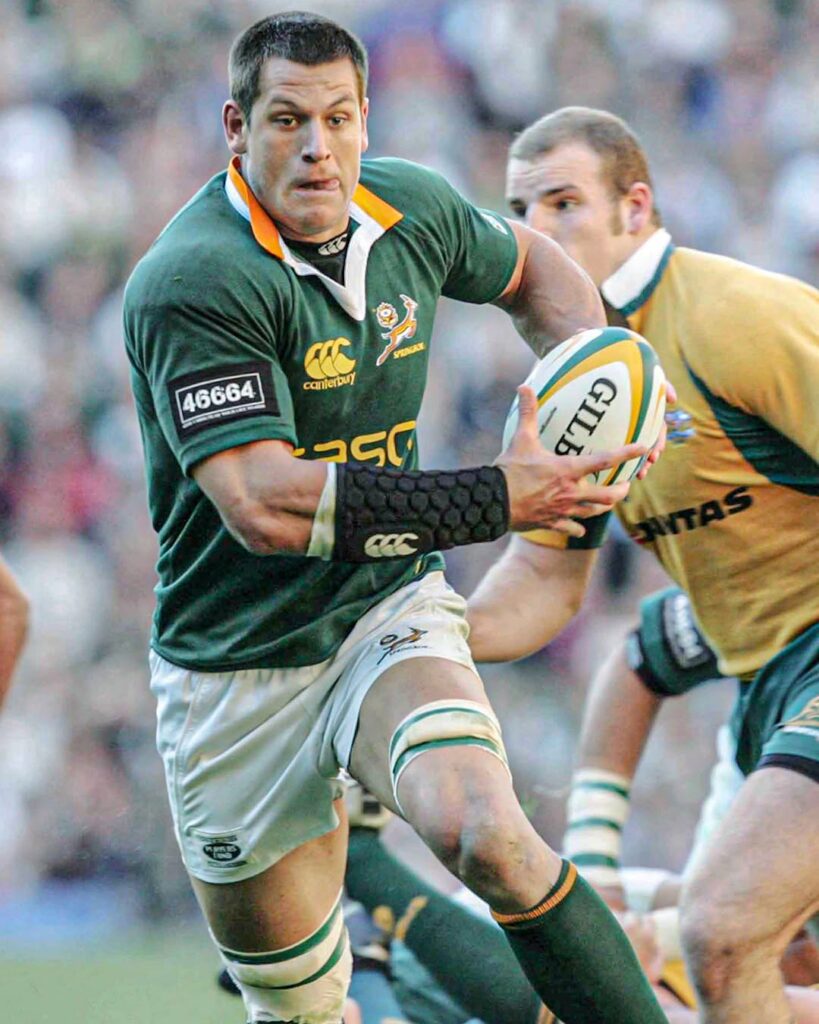
The year 2008 was when South African rugby saw the full version of Pierre Spies. Fit again, focused, and playing with a clarity that reflected the personal ground he had covered, he was exceptional across the board. He was nominated for Currie Cup Player of the Year, South African Player of the Year, and International Player of the Year.
He won South Africa’s Most Promising Player of the Year and Sportsman of the Year — that latter award crossing codes entirely, a recognition of an athletic specimen that the country’s sporting landscape rarely produces.
In 2009, his Super Rugby form for the Bulls reached a level that demanded a different vocabulary. He was not playing like a number eight. He was playing like something the position had not previously accommodated — a man with a lock’s frame, an openside’s work rate, and a wing’s finishing ability, operating all at once.
For two seasons at Loftus, in 2009 and 2010, the argument could be made without embarrassment that Pierre Spies was the best player in Super Rugby. The competition that year contained a number of genuine all-time greats. That is the company the comparison places him in.
The 2009 Lions series brought its own peculiar moment: Spies was deployed on the wing for the third Test. He was a man of 110kg with a hundred-metre sprint time that had no business belonging to a forward, and there he was on the flank, coming off the bench in the final quarter of a series South Africa had already won.
It was the kind of selection that only makes sense when the player in question defies the ordinary categories.
THE PINNACLE: THREE SUPER RUGBY TITLES AND LOFTUS AT ITS LOUDEST
The Bulls of 2007 to 2010 were one of the finest Super Rugby sides the Southern Hemisphere has produced. They won the title in 2007, 2009, and 2010, and Pierre Spies was at the centre of all three campaigns. He scored the opening try in the 2007 final against the Sharks. In the 2009 semi-final, with the match level at 20-all, he collected the ball more than sixty metres from the line and did what forwards simply do not do — stepped through two defenders and outsprinted the cover to score the try that shifted the game.
The Bulls went on to beat the Chiefs 61-17 in the final, and Spies crossed again. In 2010, the Bulls were even more formidable, finishing the regular season as the only franchise to break four hundred points.
That same year, the Blue Bulls won the Currie Cup, defeating the Free State Cheetahs 36-24 in the final at Loftus Versfeld. Super Rugby and Currie Cup gold in the same calendar year, and Spies central to both. It is the kind of domestic season that does not come around often, and those who were at Loftus throughout it know what they witnessed.
He finished his Springbok career with 53 Test caps between 2006 and 2013, seven international tries, Tri Nations honours, and a 2011 Rugby World Cup appearance in New Zealand. The career that a hereditary blood condition came within days of ending became one of the most decorated loose forward careers South African rugby has known in the professional era.
A DIFFERENT KIND OF CALLING: PASTOR, FATHER, MAN OF GOD
Pierre Spies retired from professional rugby in 2017, finishing his playing days at Montpellier in the French Top 14 under Jake White, the same coach who had first seen what he was capable of back in 2006. He retired without ceremony, in the manner of a man who had already long since made his peace with what the game could and could not give him.
By then, the next chapter had already begun in his heart. While still in France, he received what he describes as an unambiguous call to full-time ministry.
He returned to South Africa and did not treat it casually. He completed a BA degree in theology — studying with the same seriousness he had once brought to training — and served as an intern pastor at Christian Revival Church in Pretoria under the leadership of Pastor At Boshoff. He was being formed, shaped, prepared.
Then came the mandate. He and Juanne and their three children were sent to George, in the Western Cape, to lead the CRC congregation there. He is today the senior pastor of CRC George — a multicultural church whose Sunday morning service he leads every week. He preaches. He disciples. He builds.
He has described his calling in plain terms: to win the lost at any cost and to build God’s church for generations to come. There is nothing vague about it. This is not a man filling time between his rugby life and whatever comes next. This is a man who has found his life’s work and is giving it everything.
What makes his story compelling is the thread that runs through all of it without interruption. The boy who lost his father at nineteen and found faith at twenty. The player who survived a medical crisis that should have ended his career. The forward who won three Super Rugby titles and 53 Test caps and walked away from all of it without hesitation when something more important called.
Pierre Spies has always played for something larger than the scoreboard. He just does it from a pulpit now, on Sunday mornings in George, with his family beside him and a congregation that has no idea how extraordinary the man standing at the front of the room actually is.
Happy 41st Birthday, Pierre. From all of us at Just Plain Sport — the jersey was always too small to contain you, and it turns out the pulpit suits you just as well. 🎂🏉
📸 Images via SA Rugby