

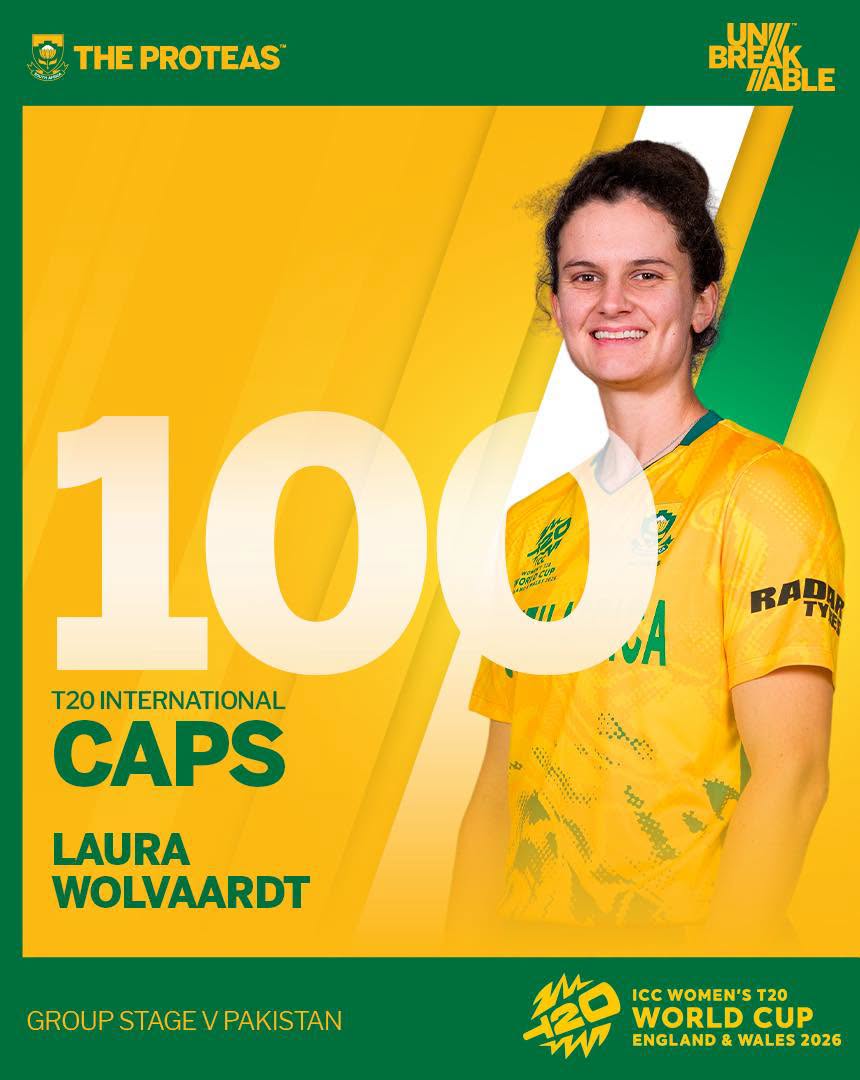
There is a version of Laura Wolvaardt that exists only on a cricket field. That is the only version the public has ever been given access to, and she has never once suggested that should change.
One hundred T20Is into a career that began when she was sixteen years old, Wolvaardt arrives at the Pakistan match at Edgbaston having offered the world exactly what she signed up to provide: runs, leadership, and absolutely nothing else.
In an era where athletes are brands, where personal lives are content and relationships are announcements, that is quietly remarkable. She has kept her private life completely her own. Not through controversy, not through careful management, but through a simple, unspoken commitment to being a cricketer first, last, and entirely.
The bat tells you everything she wants you to know.
Antoinette Muller, writing for SuperSport ahead of this milestone, captured the professional picture precisely: Laura Wolvaardt is first to training, the one who raises the intensity in the gym, the nets, the fitness sessions.
A cover drive that would make Kumar Sangakkara blush, Muller wrote, and an aura of zen that could be its own mindfulness app. That description lands because it points at something beyond technique. The composure is not a performance. It is a philosophy.
Sinalo Jafta, South Africa’s wicketkeeper and the person who watches Laura Wolvaardt from closer than almost anyone on the field, put it simply. “Wolfy leads with integrity,” Jafta said. “She brings that calmness, and that is exactly what is needed with the type of team we have.”
JAY | JPS SAYS: “There are cricketers who protect their private lives and cricketers who leverage them. Wolvaardt belongs to a third, rarer category: the ones who seem to genuinely have no interest in the conversation at all. She’s not guarded. She’s just all cricket. And that total focus — that refusal to be anything other than a batter and a captain — is part of what makes her so good at both.”
The milestone itself carries weight beyond the number. Muller’s reporting surfaces a detail that deserves to sit with the reader: Laura Wolvaardt reaches 100 T20I appearances at just 27 years and 52 days old, making her the second-youngest South African woman to do so, behind only Sune Luus.
And four of the five South African women who got there before her — Luus, Chloe Tryon, Marizanne Kapp, and Shabnim Ismail — are standing alongside her in the current World Cup squad. She did not outlast a generation. She grew up inside one.
That is the other thing the private-life silence makes possible. When you give away nothing personal, everything collective fills the space. What Laura Wolvaardt projects is not an individual image. It is a team.
She was sixteen when she debuted in 2016, in a South African women’s set-up that was semi-professional, under-resourced, and playing to sparse crowds. A decade later she leads a fully contracted national side at a World Cup where every match is broadcast and dissected globally.
That transformation happened around her and, to a significant degree, because of her.
The cricket itself has transformed too. Muller’s piece traces the evolution with clarity: the textbook technique was once considered a liability in T20, too classical for a format that rewards chaos. What followed was not an abandonment of that technique but a layering on top of it.
Cover drives gave way to sweeps. Sweeps made room for pick-ups over midwicket. The willingness to take on spin in the powerplay arrived.
The acceleration through the gears came next. And through all of it, the Wolvaardt trademarks held — the still head, the clean lines, the sense, as Muller put it, that she is playing the game half a second slower than everyone else.
That measured quality is precisely what South Africa need today. They arrive at Edgbaston having been undone by Australia’s spin in their tournament opener, losing seven wickets for 25 runs after a promising start.
Pakistan come into this match with their own urgency and a clear gameplan: open with Sadia Iqbal, build through Nashra Sundhu, squeeze the Proteas into errors and take pace off the ball on a surface expected to reward patience over power.
Against that challenge, Wolvaardt’s presence in her 100th T20I is not just ceremonial. It is structural. A calm start from the captain, as Muller notes, tends to ripple through a batting order — it gives the middle a platform rather than a rescue mission.
South Africa have reached three consecutive ICC finals. They have not yet won one. The hunger is real and Laura Wolvaardt has never hidden it, even as she has kept everything else carefully off the page.
One hundred T20Is. Every one of them played the same way. Eyes down, bat up, private life private.
Just cricket.
📸 Images via SA Cricket