

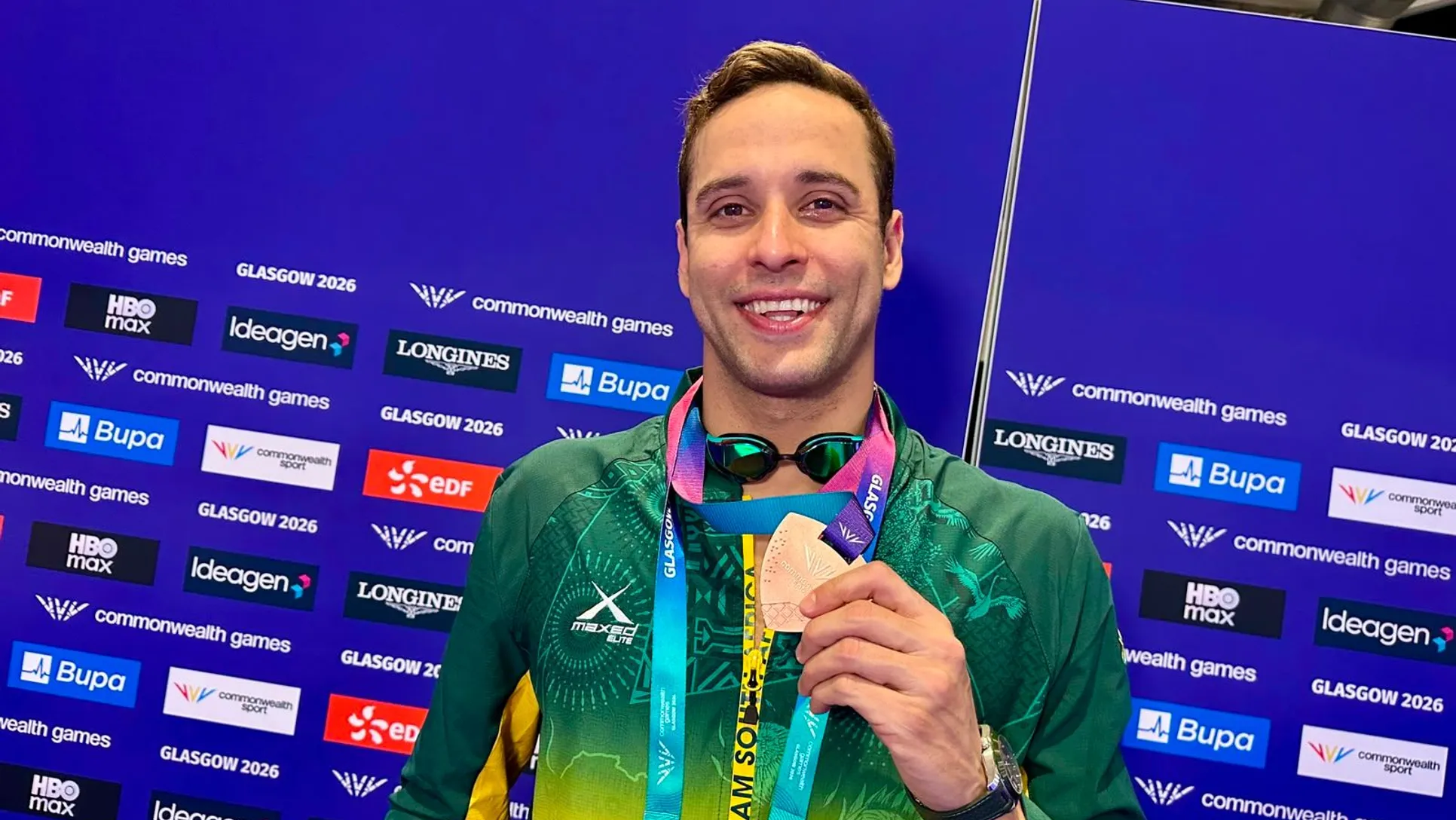
Chad le Clos stands alone. Nineteen medals, five Games, sixteen years — and on Friday night in Glasgow, the kid from Durban became the most decorated male athlete in Commonwealth Games history with a bronze medal that meant more to him than most of his golds.
Chad le Clos cemented his place in Commonwealth Games history on Friday, becoming the most decorated male athlete in the competition’s history after claiming his 19th career medal. The record 19th medal took him past shooters Phil Adams of Australia and Mick Gault of England, who had shared the honour for years. At 34, in a sport that chews up bodies well before that age, Chad le Clos did it anchoring a relay leg for his country rather than chasing an individual crown.
This is where the story actually lives. Not in the medal count, but in the sixteen years it took to get there. Chad le Clos made his Commonwealth debut in 2010 in New Delhi, where he collected five medals at just 18 years old. He was a teenager announcing himself to the world before most of his current teammates could swim a length unassisted.
Four Games later, that teenager is a father-figure in the change room. He won seven medals in Glasgow in 2014, five in Gold Coast in 2018, one in Birmingham in 2022, and now the record-breaking medal back in Glasgow. That 2014 haul matched Ian Thorpe’s mark for the most medals won by anyone at a single Games. Two Glasgows, twelve years apart, both landmarks. That’s not a coincidence — that’s a career built to last.
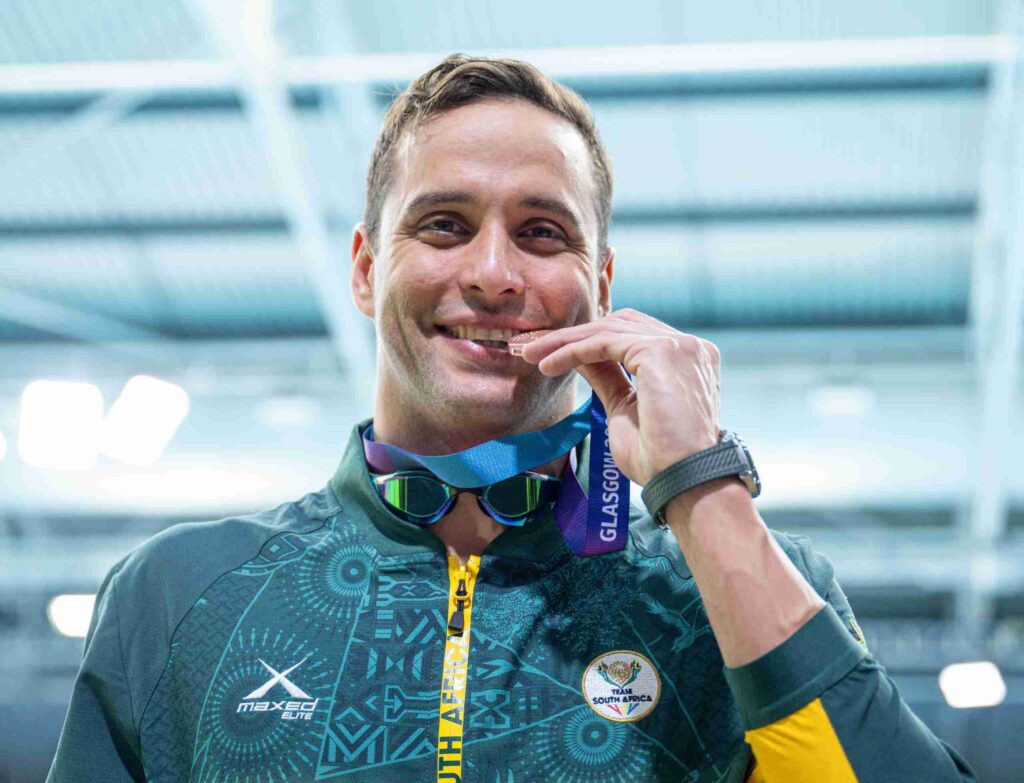
Friday’s medal came in the pool, not on an individual podium. Chad le Clos teamed up with Pieter Coetzé, Guy Brooks and Ruard van Renen to finish third in the men’s 4x100m freestyle relay in 3:13.99, behind Australia and England, with le Clos’s anchor split of 48.29 seconds the fastest of the South African quartet. He didn’t just make history — he swam the fastest leg of the race to get there.
“Sixteen years, five Games, one number nobody else can touch — that’s not talent, that’s stubbornness. And South Africa will take stubborn over talent any day of the week!” – 🎙️Jay
The emotion afterwards told you everything about what this chase had cost him. Chad le Clos said it had been an emotional event, revealing that his father was also in tears at the achievement. “I’ve never given up,” he said, and after eight years of hunting this exact record, through injuries and setbacks that would have ended most careers, he didn’t need to say much more than that.
There’s a symmetry to Friday night that le Clos himself pointed to. Twelve years earlier, he won a medal in this same relay event as a 22-year-old alongside Roland Schoeman, who was 34 at the time. Now Chad le Clos is 34, racing alongside a new generation of youngsters he believes have their own incredible futures ahead of them. The torch doesn’t just get passed. Sometimes it gets carried by the same hands for two decades.
And he isn’t done yet. Le Clos remains entered in the 50m and 100m butterfly events later in these Games — his signature distances, the ones that made him a global name in the first place. Every medal from here is pure margin on a record that may not be touched for a generation.
Because the Commonwealth Games is only one chapter. Chad le Clos beat Michael Phelps to Olympic gold in the 200m butterfly at London 2012, added three more Olympic medals, and has collected 16 world titles across a career defined mostly by that same stroke. Nobody outworks a résumé like that by accident.
What makes this record land differently is where he’s chosen to put his energy off the podium. He’s built a swimming academy back home, with clubs and members already running into the thousands, aimed squarely at the next generation of South African swimmers coming up behind him. The most decorated male athlete in Commonwealth Games history is spending his moment at the top building the ladder for others to climb.
Durban to Delhi to Glasgow, twice. Eighteen to thirty-four. Five golden bronzes among nineteen career medals, and a country that gets to claim every single one of them. This is what longevity actually looks like in a sport built to punish it.
📸 Images via Commonwealth Games / Anton Geyser