

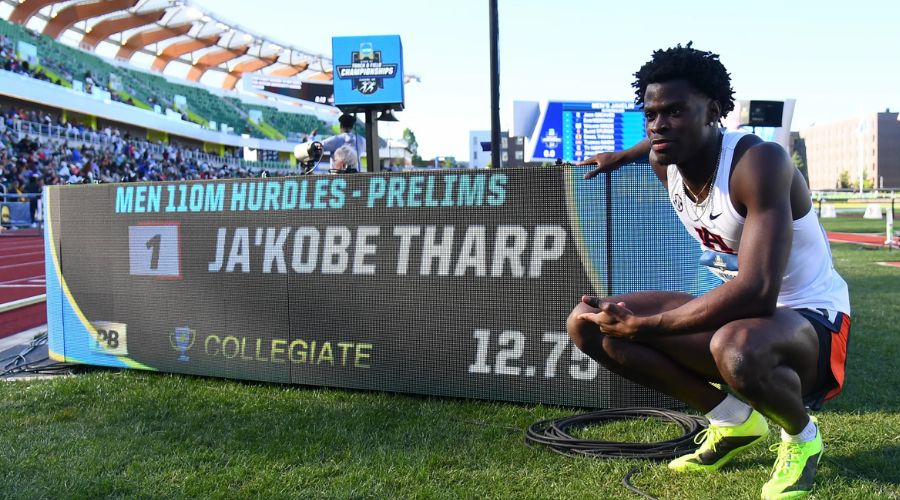
At just 20 years old, Auburn University’s Ja’Kobe Tharp has written his name into the history books in the most emphatic fashion possible — running 12.75 seconds in the men’s 110m hurdles at the 2026 NCAA Outdoor Track and Field Championships in Eugene, Oregon, to shatter Aries Merritt’s world record that had stood since 2012.
What makes this performance even more extraordinary is where it happened.
This was not a Diamond League final. This was not a World Championships showpiece.
This was a NCAA semi-final — a survive-and-advance heat — and Ja’Kobe Tharp ran the fastest 110m hurdles in human history in it, becoming the first man to break the 12.8-second barrier.

The Tennessee-born hurdler was ruthlessly focused going in, with his coaches giving him one simple instruction. “Coaches said, ‘Execute,’” Ja’Kobe Tharp said on ESPN after the race. “My last three hurdles were kind of trash… That was not a picture-perfect race. I have more in my legs.”
Read that again. The fastest 110m hurdles ever run — and the man who ran it says he wasn’t even close to his best.
“I knew I had that in my legs,” Tharp added. “But it wasn’t on my bingo card before this meet, not at all. To see that, it was like, ‘Ahhhh.’ I’m speechless, seriously.”
Ja’Kobe Tharp also wiped out the collegiate record of 12.98 seconds set by the great Grant Holloway in 2019 — a mark many thought would stand for a generation.
He is now the first athlete since Dwight Stones broke a world record in the high jump at the NCAA Championships 50 years ago to achieve the feat at this level of collegiate competition.
The leap in Tharp’s progression is almost incomprehensible.
His previous personal best stood at 13.01 seconds — good enough to win the 2025 USA Outdoor Championships, but placing him outside the 30 fastest men in history. In one race, he went from a 13.01 athlete to the greatest 110m hurdler who has ever lived.
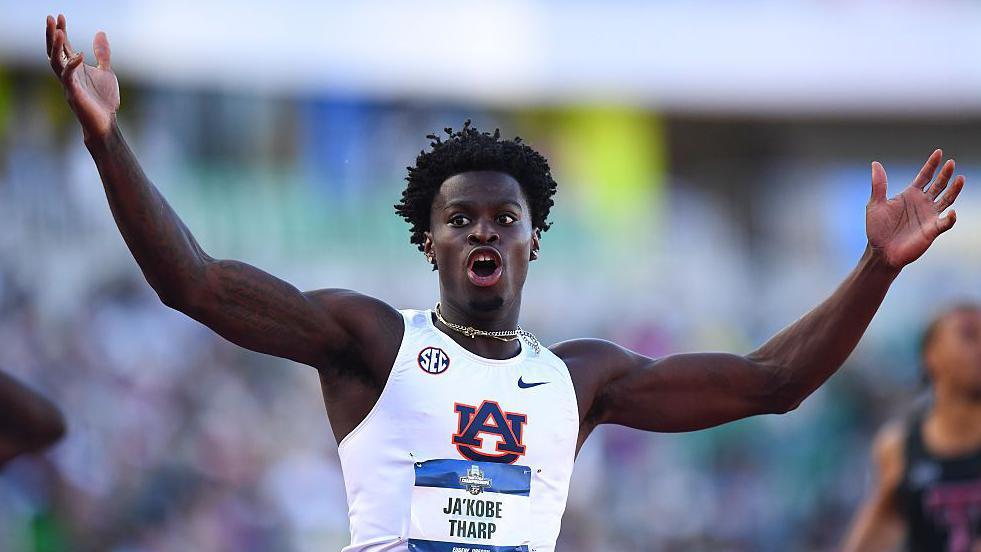
To put Tharp’s 12.75 in a South African context, the national record stands at 13.11 seconds — set by Cape Town’s Antonio Alkana in Prague in June 2017, a landmark performance that also doubled as the African record. That gap of 0.36 seconds may sound small, but in hurdles terms it is a chasm.
🇿🇦 South Africa has produced genuinely world-class hurdlers over the decades. Alkana broke the 13.24 mark set by London 2012 Olympic finalist Lehann Fourie, which had itself surpassed Shaun Bownes’ 13.26 held since 2001. It is a proud lineage.
But on the night of 10 June 2026, the world witnessed something that transcended the history of the event entirely. Ja’Kobe Tharp returns to Hayward Field on Friday for the final, looking to defend his NCAA outdoor title.
If his own words are anything to go by, the sport of athletics may not yet have seen the best of Ja’Kobe Tharp. That is a terrifying thought for the rest of the world — and a thrilling one for everyone watching.
📸 Images via The Times / World Athletics / BBC