


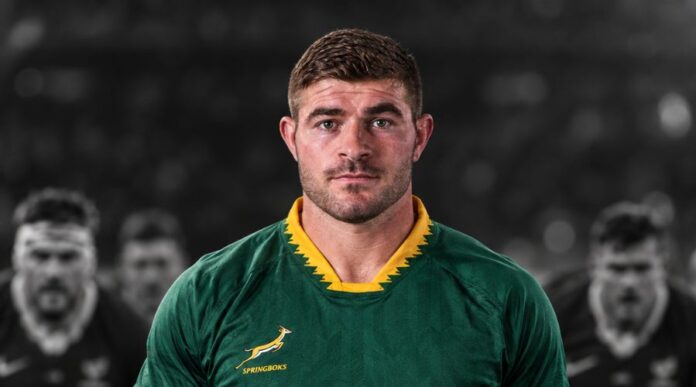
Birthday Tribute | Malcolm Marx | 13 July 2026 | Kubota Spears · Springboks · Rugby Union
There are hookers who do a job, and there are hookers who redefine what the job even means. Malcolm Marx belongs firmly in the second category. Born on this very day, 13 July 1994, in Germiston, he turns 32 today. And in a position built on unglamorous graft, he has somehow become the most talked-about forward in world rugby.
Happy Birthday, Malcolm. From a schoolboy flanker in Germiston to World Rugby’s official Player of the Year, this is a story about getting back up, again and again, until nobody could ignore him anymore.
GERMISTON: WHERE THE HARD WORK STARTED
Marx grew up in Germiston, on Johannesburg’s East Rand, in the KwaDukathole area — not the easiest start, and not one built on privilege. What he had instead was discipline, and a body built for contact rugby from a young age.
He was raised alongside his sister Carina and brother Jean Pierre. Rugby ran through the Golden Lions age-group system early — Under-13 Craven Week in 2007, Under-16 Grant Khomo Week in 2010, a place in the South Africa Academy by 2011. None of that guaranteed anything.
Plenty of talented Lions juniors never make it past provincial level. Malcolm Marx did, because the physical edge that would later define his professional career was already visible as a schoolboy.
He attended King Edward VII School in Johannesburg, a school with a serious sporting pedigree. It was there that former Springbok coach Heyneke Meyer, watching him play, suggested Marx should try his hand at hooker. At the time, Malcolm Marx was playing flanker. That one piece of advice changed the entire shape of his career.
FROM FLANKER TO HOOKER: THE MOVE THAT CHANGED EVERYTHING
The position switch stuck. Marx played for South Africa Schools in 2012, then for the University of Johannesburg in the 2013 Varsity Cup, scoring four tries in eight appearances as a teenage forward who clearly had more than just set-piece work in him.
His senior debut came on 7 March 2014, starting at hooker for the Golden Lions in an 18-16 Vodacom Cup win over the Leopards XV in Potchefstroom. He was 19, and needed special permission from SARU to play at that level. Later that year he was named in South Africa’s Under-20 squad for the Junior World Championship in New Zealand, scoring a try against Scotland before a knee injury cut his tournament short.
By 2014 he was also part of the Lions’ Super Rugby squad. The flanker who’d been told to try hooker was now doing both jobs in one body — set-piece stability with a loose forward’s work rate around the field. It is that combination, more than anything else, that has defined Malcolm Marx’s rugby ever since.
DOWN ON THE GROUND, UP AGAIN: THE SETBACKS THAT TRIED TO STOP HIM
Marx’s career has never run in a straight line upward. It has been interrupted, more than once, right when it mattered most.
In May 2018, a high-grade hamstring injury against the Hurricanes cost him six weeks and South Africa’s June Tests, right in the middle of a season where he was matching his own try-scoring records.
At the 2019 Rugby World Cup in Japan, he started the tournament opener against New Zealand, then spent most of the competition on the bench behind Bongi Mbonambi — only getting his moment in the final itself, coming on after twenty minutes when Mbonambi went off with a head injury.
Then, at the 2023 Rugby World Cup in France, Marx made the squad as a Springbok looking to defend the title, only to pick up a knee injury in training that ruled him out of most of the tournament.
A Super Rugby season, and two World Cups. Three different times rugby found a way to knock him down before the biggest moments. Each time, Malcolm Marx got back up and kept playing.
2017: THE YEAR THE WORLD TOOK NOTICE
If there’s one season that turned Marx from a promising Lions forward into a Springbok the whole rugby world was watching, it’s 2017. He started twelve Tests that year, from South Africa’s series against France in June through to the end-of-year tour finishing against Wales in Cardiff.
The numbers back up the reputation. In the Newlands Test against New Zealand — a match South Africa lost 25-24 — Malcolm Marx put in one of the standout performances of the series, finishing with a strong carrying and tackling count, four turnovers won, and a try. Four turnovers in a single Test against the All Blacks is the kind of breakdown work that gets coaches and opponents talking.
By the end of the year he’d been voted SA Rugby Player of the Year and SA Rugby Young Player of the Year, on top of being named Super Rugby Player of the Tournament.
2018 only built on it. He matched his own tally of 12 tries in a single Super Rugby season — still a shared record for the most by a forward in one campaign — and was shortlisted for World Rugby Player of the Year, an award eventually won by Johnny Sexton. He finished his time at the Lions as the joint top try-scorer in the franchise’s history, with 27.
TWO WORLD CUPS, ONE WORLD AWARD
Marx has now won the Rugby World Cup twice with South Africa, in 2019 and 2023, despite injuries denying him a full run in both tournaments. That alone puts him in rare company. But the moment that finally, officially, confirmed what South African rugby had known for years came in November 2025, when Malcolm Marx was named World Rugby’s Men’s 15s Player of the Year.
It was a long time coming. He’d been nominated back in 2018 and lost out. This time there was no argument. Hookers rarely win the game’s biggest individual award — it tends to go to backs who score tries and make headlines in open play.
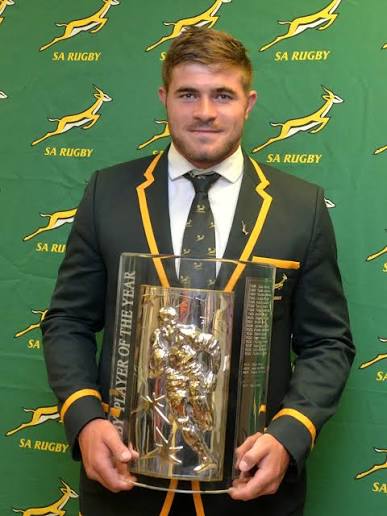
Marx won it doing the unseen work: lineout throwing under pressure, ball-carrying through contact, and disruption at the breakdown that has made him one of the most feared forwards in the sport to play against. He was also named in World Rugby’s Dream Team of the Year in 2021, 2022, 2024 and 2025 — recognition that has followed him consistently, not just in one standout season.
In 2020, when the Lions cancelled contracts under South African rugby’s Covid-era Industry Salary Plan, Malcolm Marx moved to Japan, first with NTT Shining Arcs before settling with Kubota Spears Funabashi Tokyo Bay. He has built a career there while continuing to answer every call-up for the Springboks, now closing in on 90 Test caps.
STILL GOING: FATHER, HUSBAND, HOOKER
Off the field, Malcolm Marx is married to Kirsten, and the couple have two children, daughter Kenna and son Jake Justin, born in June 2024. Family life has become as much a part of his story now as rugby itself, even as he continues to play at the highest level in Japan and for South Africa.
He’s also known for the large back tattoo he carries — a black-and-grey mural covering almost his entire back, blending a cross, a winged angel figure and Colosseum-style arches.
It made headlines when spotted in Dublin, and it fits a player who has spent his whole career carrying weight that others don’t see: the physical toll of professional hooker play, World Cup campaigns interrupted by injury, and the responsibility of leading alongside senior Springboks like Siya Kolisi and Eben Etzebeth. He has never put it down. He has just kept getting up.
Happy 32nd Birthday, Malcolm. From all of us at Just Plain Sport — the schoolboy from Germiston who was told to try hooker is now, officially, the best in the world at it. 🎂🏉