

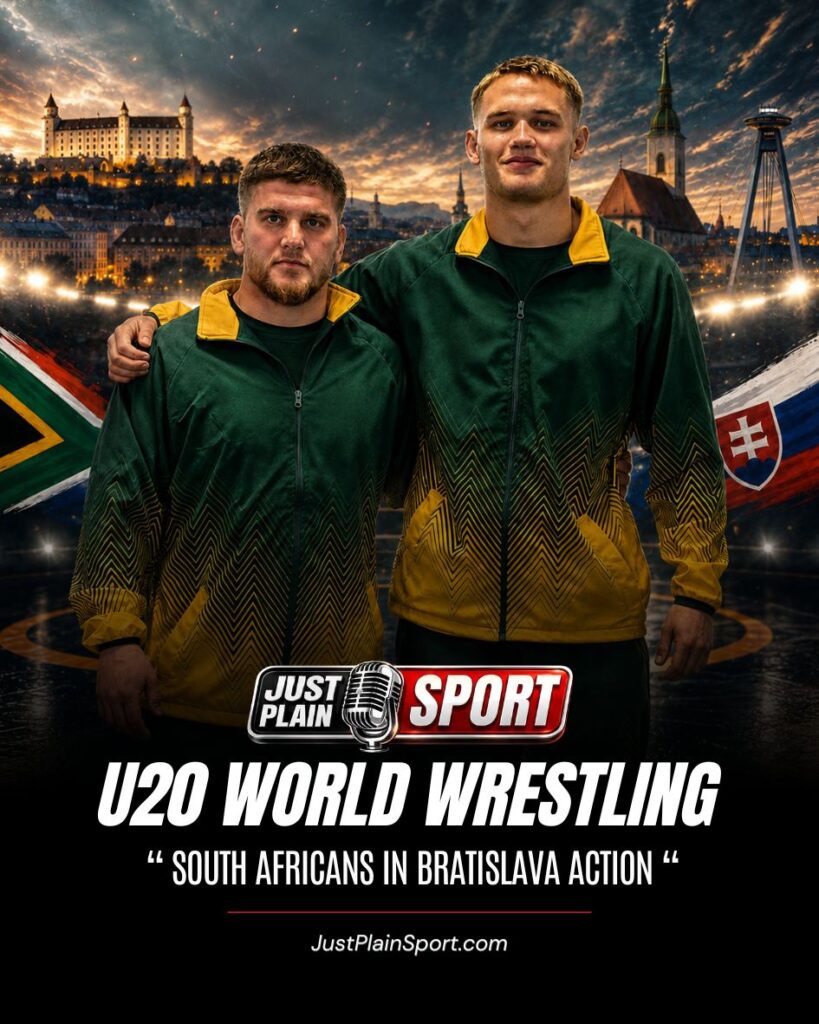
The U20 World Wrestling Championships run in Bratislava from 16 to 23 August 2026, and South Africa has a wrestler in the field — Slade Shadowshot, entered at 79kg Freestyle, with the men’s freestyle programme filling the closing days from 20 to 23 August.
Most South African sports fans have never followed a wrestling bracket in their lives. That is not a knock on the audience. It is a description of what the sport has been given in this country, and it is worth explaining before Friday’s bouts start.
Start with the event itself. The U20 World Wrestling Championships is United World Wrestling’s flagship junior tournament, staged annually across three disciplines — men’s freestyle, women’s freestyle and Greco-Roman. It is the level where Olympic medallists are first identified, usually years before they reach a senior podium.
The format is a single-day grind per weight class. Wrestlers work through a knockout bracket, and anyone beaten by an eventual finalist drops into repechage — a second route back toward the bronze medal bouts. It means a competitor can lose early and still finish on the podium, but only by winning consecutive matches on the same day against opponents who arrived fresher.
Each bout is six minutes, split into two three-minute periods. Points come from takedowns, exposure, mat returns and defending against them. There is no hiding in a low-scoring holding pattern the way there is in some codes — passivity gets penalised, and the clock is short enough that a single scoring sequence decides brackets.
That is the machinery. The harder thing to convey is where South Africa sits inside it.
Wrestling at world level is dominated by nations with structures South Africa simply does not have. Iran, Japan, the United States, Georgia, Turkey and the former Soviet republics run wrestling as a school-level national sport, with full-time coaching, state funding and domestic competition depth measured in thousands of registered athletes per weight class.
South African wrestling operates on club coaching, volunteer administration and family money. There is no professional domestic circuit, no broadcast revenue, no academy pathway running alongside rugby and cricket. Athletes fund international travel largely themselves, and often train in facilities shared with other codes.
“Ask a South African to name a Springbok loose forward and they’ll give you four. Ask them to name a South African wrestler and you get silence — that’s the gap this tournament exposes!” – 🎙️Jay
Understand that, and the entry list starts reading differently. Reaching a U20 World Championships from South Africa is not the natural next step on a funded conveyor belt. It is an outcome that requires a wrestler and the people around them to absorb costs and coaching gaps that competitors from the sport’s heartlands never encounter.
Which is why the measure of success at Bratislava is not a medal. It is competitiveness — bouts that stay live into the second period, scoring sequences landed against wrestlers with a decade of structured coaching, evidence that the technical standard being taught at home holds up against the standard being taught in Tehran or Tokyo.
That is the read on Shadowshot’s 79kg campaign, and on the wider question of what South African wrestling can produce. The weight class sits in the demanding middle range where technique and conditioning have to arrive together, above the speed-driven lighter divisions and below the heavyweight brackets.
Coach Shane Goosen travels with him, and at a tournament run at this pace the corner matters. The thirty seconds between periods is where a bout gets rescued or lost.
There is also a longer argument running underneath the results. Visibility at a United World Wrestling flagship event is what federations take into funding conversations. Every South African name on a Worlds start list makes the case for the next one.
Friday, 21 August is when the answers start arriving in Bratislava.