


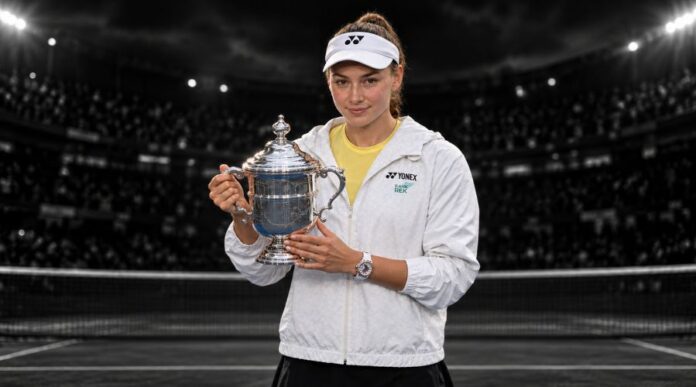
Elena Rybakina became the world number one in women’s tennis on 14 September 2026, two days after beating Aryna Sabalenka 6-4, 5-7, 6-2 in the US Open final in New York. The 27-year-old is the 30th woman to hold the top ranking since the computerised WTA rankings began in 1975, and the first player from Kazakhstan, man or woman, to get there.
She leads Sabalenka by 2,146 points. The WTA ranking is a rolling 52-week points total, updated every Monday, so a player keeps the top spot only as long as the previous year’s results keep paying. Sabalenka had held it for 99 straight weeks, a run that began in October 2024 and ended the moment Rybakina reached the semi-finals in New York, which settled the handover before the final was played.
The WTA Top 10 On 12 October 2026
- Elena Rybakina (Kazakhstan) — 9,696 points
- Aryna Sabalenka — 7,550
- Mirra Andreeva — 6,371 (up two places)
- Jessica Pegula (United States) — 6,225 (down one)
- Coco Gauff (United States) — 5,974 (down one)
- Elina Svitolina (Ukraine) — 5,024 (up one)
- Karolína Muchová (Czech Republic) — 4,773 (up one)
- Linda Nosková (Czech Republic) — 4,679 (down two)
- Iga Świątek (Poland) — 3,999
- Marta Kostyuk (Ukraine) — 3,910
How Did Elena Rybakina Win The US Open Final?
She converted three break points from twelve, and she took them in the games that decided sets. Sabalenka, the two-time defending champion, hit 35 unforced errors, fourteen of them in the first set.
Sabalenka answered in the second. She broke Rybakina for the first time in the final game of the set to force a decider, then lost the third 6-2.
| Rybakina | Sabalenka | |
|---|---|---|
| Sets won | 2 | 1 |
| Games won | 17 | 13 |
| Prize money | $5,500,000 | $2,800,000 |
That was the largest singles cheque paid at a Grand Slam to that point. It was Rybakina’s third major, after Wimbledon in 2022 and the Australian Open in January, and three of her four major finals have now been against Sabalenka. She has won two of them.
The Road To World Number One
The ranking was not built in New York. It was built across a season in which Rybakina won three titles and kept meeting Sabalenka at the end of tournaments.
- Australian Open, 31 January: beat Aryna Sabalenka 6-4, 4-6, 6-4 for a second major
- Indian Wells, March: lost the final to Aryna Sabalenka 3-6, 6-3, 7-6(8-6)
- Stuttgart, April: won the title
- Wimbledon, July: seeded second as the 2022 champion, lost in the third round to Elise Mertens
- US Open, 12 September: beat Aryna Sabalenka 6-4, 5-7, 6-2 and took the number one ranking
How The Wimbledon Seeds Finished
That third-round exit kept Sabalenka at the top for another two months, and the fortnight gutted the top of the draw.
- Aryna Sabalenka — fourth round
- Elena Rybakina (Kazakhstan) — third round
- Iga Świątek (Poland) — third round
- Jessica Pegula (United States) — quarter-finals
- Mirra Andreeva — second round
- Amanda Anisimova (United States) — third round
- Coco Gauff (United States) — semi-finals
- Elina Svitolina (Ukraine) — first round
- Linda Nosková (Czech Republic) — champion
- Karolína Muchová (Czech Republic) — runner-up
Nosková beat Muchová 6-2, 5-7, 6-3 on 11 July, the first Grand Slam singles final between two Czech women in the professional era. Nosková was 21, the youngest Wimbledon women’s champion since Petra Kvitová in 2011, and it was her first major final.
Rybakina then lost her first match as number one. At the China Open on 3 October, Alina Charaeva, ranked 118th, beat her 3-6, 6-4, 6-3 in two hours and eleven minutes. Rybakina served seven double faults; Reuters reported that Charaeva took five of her eight break points and won 76 percent of the points behind her first serve. Rybakina had skipped Kazakhstan’s Billie Jean King Cup campaign after what she described as a physically demanding period, and she withdrew from Wuhan after Beijing.
What Rybakina Puts Back Into Kazakh Tennis
Rybakina was born in Moscow on 17 June 1999 and played in the Russian system until June 2018, when she took Kazakhstani citizenship at nineteen, having just cracked the top 200.
When she won Wimbledon in 2022 the Kazakhstan Tennis Federation offered her a personal bonus for it. She turned the bonus down, asked that the money go into the junior programme instead, and said she would fund the next lot herself.
“Now it’s my turn to help the younger generation develop.” – Elena Rybakina
She made it good in March 2023, picking 14 junior girls herself and handing each of them 2.5 million tenge, 35 million tenge in total, out of her own Wimbledon prize money. A further slice of the same winnings went to an animal shelter in Astana.
She has now earned $35,318,052 in prize money, eleventh on the all-time list, and the arrangement has not changed since: the player writes the cheques that keep the junior girls travelling. Before Rybakina reached the top 10 in January 2023, no Kazakhstani player of either sex had ever been in it. The country now has a world number one, three Grand Slam titles and a WTA Finals champion, all in the same person, and she is the one paying the juniors’ bills.
Where Do South Africa’s Women Rank?
Nowhere near this, and not for a long time. Amanda Coetzer reached world number three on 3 November 1997, and that remains the highest ranking any South African woman has held in the Open era. She was the first South African woman in that era to reach a Grand Slam singles semi-final, and she did it three times, at the Australian Open in 1996 and 1997 and at the French Open in 1997. She retired in 2004 with nine singles titles.
Joannette Kruger reached number 21 in 1998 and now works as a consultant to Tennis South Africa on women’s high-performance tennis. After that the line drops. Chanelle Scheepers hit number 37 on 10 October 2011, the year she won in Guangzhou to become the first South African woman to take a WTA title since Coetzer in 2003. Chanel Simmonds peaked at 162 in May 2013.
The team record runs the same way. South Africa won the Federation Cup in 1972 with Patricia Walkden and Brenda Kirk. In April 2026 the side played in Europe/Africa Zone Group II, the third tier of the Billie Jean King Cup, in Banja Luka, and finished second in the pool on three ties to one, winning eight rubbers to four, beaten only by Bulgaria, who went up along with Greece. South Africa stayed where they were.
South Africa’s players have been going the other way. Isabella Kruger, daughter of the late Springbok flank Ruben Kruger and the country’s top-ranked woman in February 2024, signed with Auburn in May 2025 and now plays American college tennis. Rybakina turned down exactly that option in 2018, and eight years later she is the one paying for somebody else’s plane ticket.