


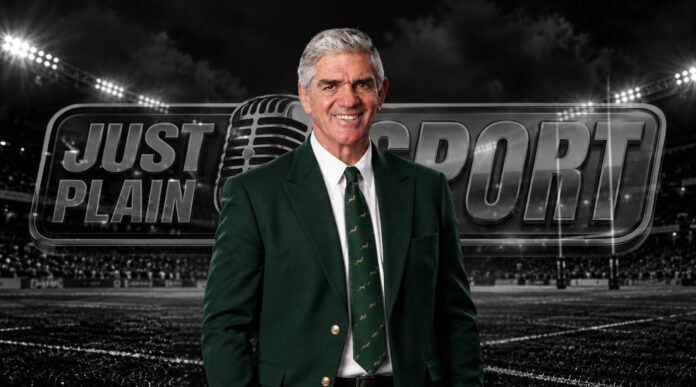
Put him in front of a monitor with ninety seconds of replay and he will tell you why a Test was lost — not the moment it turned, but the structural reason, the selection that caused it, the shape that was never going to hold. Happy Birthday to Nicholas Vivian Haward Mallett, born on 30 October 1956 at Hertford Heath, England, 70 today.
Nobody in the game does that part of it better, and nobody has been doing it longer.
THE BRAIN ARRIVED BEFORE THE DATA DID
Long before “analytics” became a rugby word, he was coaching from first principles that the modern game has since adopted wholesale: width as a default rather than a gamble, tempo as a weapon, a bench picked to change a match instead of survive it, and a squad deep enough that nobody was undroppable.
In 2015 a global consultancy built a Six Nations analysis team around data, and brought him in as the rugby brain to sit alongside it. He was hired for the way he thinks, not for the caps he won.
“Nick Mallett is that guy who makes listening to boring post-game analytics worth tuning in! He calls a spade a spade. What a guy!” – 🎙️Jay
BORN ABOVE A MUSIC ROOM, RAISED IN A HEADMASTER’S HOUSE
His father, Tony Mallett, played 75 first-class matches — 33 of them for Kent — and won Oxford Blues in cricket, squash and table tennis. He was teaching at Haileybury College in Hertfordshire when his son was born above the school’s music room.
Six weeks later the family sailed for Rhodesia, where Tony Mallett joined the staff of the newly founded Peterhouse. In 1963 he was appointed Principal of Diocesan College in Cape Town — Bishops — a post he held from 1964 to 1982. Xhosa was introduced as a subject under him and black pupils were admitted, in the hardest years of apartheid. Mallett House at the school carries his name.
The son went to St Andrew’s College in Grahamstown, made the 1st XV and the 1st XI, then took a BA in English and History at UCT. He went up to University College, Oxford, in 1979, won Blues in both rugby and cricket, captained the university, and played first-class cricket for Oxford.
TWO CAPS, FOUR CURRIE CUPS AND FIVE YEARS IN THE JURA
He played in four straight Currie Cup-winning Western Province sides between 1982 and 1985. On 20 October 1984, ten days short of his 28th birthday, he became the 541st Springbok, picked at No 8 against the South American Jaguars at Loftus Versfeld, and scored a try in the 32-15 win. He played once more, at Newlands a week later.

Isolation closed the door on the rest. He went to Rovigo in Italy as a player-coach, then spent five seasons at St Claude in the French second division, in the Jura near the Swiss border, learning the language and running the clubhouse bar, followed by four years at Boulogne-Billancourt in Paris.
That decade is where the rugby brain was built. He spent his twenties and thirties inside a European game that argued about structure while South African rugby still largely argued about forwards.
SEVENTEEN IN A ROW, AND A BLUEPRINT THE GAME CAUGHT UP WITH
He coached False Bay from 1994, took over Boland in 1995, was an assistant to the Springboks in 1996, and got the job itself in 1997.
South Africa then won 17 consecutive Tests between August 1997 and December 1998, equalling the world record. Nick Mallett was head coach for 16 of them.
The scorelines inside that run still look misprinted. France beaten 52-10 in Paris, Scotland 68-10 at Murrayfield, Ireland held to 33-0, Wales put away 96-13. In 1998 the Springboks won the Tri Nations unbeaten for the first time.
The streak ended against England at Twickenham on 5 December 1998. He finished with 27 wins from 38 Tests, a 71 percent return that stood for years as one of the best in Springbok history.
“Nick Mallett won 17 Tests in a row playing width and tempo when the rest of South African rugby still thought a big pack was enough. Thirty years later he’s still the first man in the studio to see it coming. What a Saffa Sport Legend!” – 🎙️Jay
THE CALL HE HAS NEVER HIDDEN FROM
In July 1999 he left Gary Teichmann — his captain in 36 Tests and through most of the winning run — out of the squad two months before the World Cup.
The tournament had everything but the trophy: Italy beaten 101-0, England dismantled 44-21 in the quarter-final with Jannie de Beer’s five drop goals, then Stephen Larkham’s 48-metre drop goal in extra time for Australia. South Africa beat New Zealand 22-18 for third.
He has said in public, repeatedly and on the record, that dropping Teichmann was the biggest mistake of his coaching life and that losing the trust of his players cost South Africa that World Cup. The willingness to say it out loud is a large part of why his analysis carries weight now.
He resigned in September 2000, at the start of a disciplinary hearing, after accusing the union of greed over inflated Tri Nations ticket prices.
PARIS, ROME AND THE ENGLAND JOB HE SAID NO TO
Stade Français signed him in December 2001. He coached the Paris club from 2002 to 2004 and won back-to-back French championships in 2003 and 2004.
He returned as Western Province’s director of rugby from 2005 to 2007 and set up the WP Rugby Institute in Stellenbosch, which fed a generation of Springboks into the professional system.
Italy appointed him in October 2007. The record was nine wins in 42 Tests, but on 12 March 2011 at the Stadio Flaminio his side beat reigning Six Nations champions France 22-21, Italy’s first win over them in the tournament. The RFU came for him twice about England. He turned the first approach down.
WHY THE PANEL GOES QUIET WHEN HE STARTS
He joined SuperSport as an analyst in 2012, took a seat on the IRB rugby committee in 2013, and became News24’s headline rugby columnist in 2022. He is still on air live every week in 2026, and still on the podcasts, dismantling scrum penalties, officiating failures and selection calls.
What separates him is that he is never describing what happened. He explains the mechanism — why that scrum earned the penalty, why that bench split was always going to fail in the last twenty, why a player is a Test captain in waiting before anyone else has said it out loud.
Supporters argue with him constantly. They also wait to hear him before they decide what they think.
Happy 70th Birthday, Nick. From all of us at Just Plain Sport — two caps, 38 Tests and thirty years of being the first person in the room to see it coming. 🎂🏉