


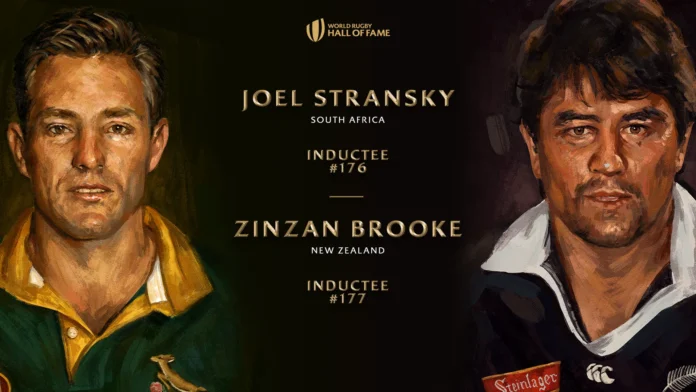
Springbok hero Joel Stransky and All Blacks great Zinzan Brooke are the first two names in the World Rugby Hall of Fame class of 2026, confirmed at a dinner in Cape Town on Thursday night ahead of the second Test of the Rugby’s Greatest Rivalry series between South Africa and New Zealand.
Stransky enters as inductee number 176. Brooke follows as 177. Five more names land on Monday, 7 September, which will take the total to 182 members since the Hall of Fame opened in 2006.
The timing is not an accident and the pairing is not a coincidence. Thirty years ago these two faced each other in the last Test series between the Springboks and the All Blacks, and both are remembered for the same thing that almost nobody in their position was supposed to do — drop a goal that decided something enormous.
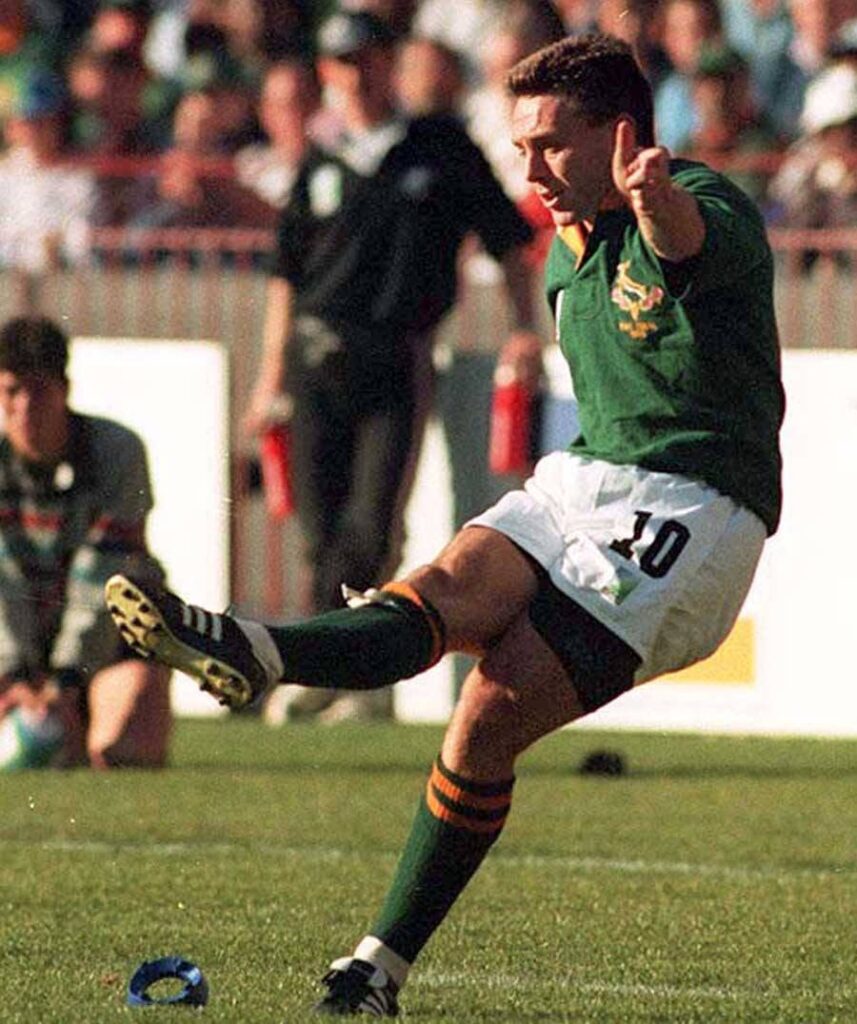
Stransky’s came at Ellis Park on 24 June 1995. He kicked every one of South Africa’s points in the 15-12 win over New Zealand, and the extra-time drop goal that settled it has been replayed in this country more often than any other piece of rugby footage ever shot here.
Brooke’s came in the semi-final of that same tournament, 38 metres out against England, and then again a year later when he landed the three-pointer that clinched New Zealand’s first series win on South African soil.
“Two men who did the exact same thing to different scoreboards, going in on the same night, in the same city, thirty years later. Rugby doesn’t script it better than that!” – 🎙️Jay
The numbers behind Stransky’s induction are tighter than most people assume. He played 22 Tests for the Springboks between 1993 and 1996, scoring six tries and 240 points. The World Cup final sat almost exactly in the middle of that career.
His first cap came in a win over Australia in Sydney in July 1993, and his first Test try followed in the return fixture in Brisbane.
Before any of that he was a Currie Cup winner at 20, part of the Natal side that beat Northern Transvaal in 1990 to take the trophy for the first time in the union’s history. Two seasons in Italy with L’Aquila and San Donà followed, then the return home and the World Cup.
Professionalism took him to Leicester, where he scored 896 points in 73 appearances and helped the Tigers to the Pilkington Cup and the Allied Dunbar Premiership title. He has since spent two decades in front of a camera as a presenter, commentator and analyst, alongside a business career in sports marketing.
Brooke’s case is built on a different kind of evidence. Jeff Wilson once described him as a team in a No 8’s body, and the description has stuck because it was accurate.
He won 58 caps for New Zealand across a Test career spanning 12 years, starting 54 of them, and appeared at three Rugby World Cups. His 17 Test tries were a record for a forward at the time.
He was a World Cup winner at 22 in 1987. He played 100 matches for the All Blacks in total once the 42 non-international games are counted, turned out 22 times for the Māori All Blacks, and scored 94 tries in 140 games for Auckland.
As captain of the Auckland Blues he led the side to back-to-back Super 12 titles in 1996 and 1997. He played alongside his younger brother Robin for both club and country, spent time in Italy with Lazio, went to Harlequins as a player and then head coach, and finished at Coventry in 2002/03. In 1997 he was appointed a Member of the New Zealand Order of Merit for services to rugby.
World Rugby Chair Brett Robinson, who played against both men, put Stransky’s moment in the context that South Africans understand instinctively.
Brett Robinson, World Rugby Chair:
“Joel’s name will forever be linked with one of rugby’s most powerful and unifying moments, his winning drop goal at Ellis Park in the Rugby World Cup 1995 final giving us the iconic image of Nelson Mandela in a Springbok jersey alongside captain Francois Pienaar as a nation came together.”
On Brooke, Robinson made the point that the drop goal was never the anomaly — it was the proof.
Brett Robinson, World Rugby Chair:
“Zinzan, himself a Rugby World Cup winner in 1987, challenged what people thought a forward could be with his skill and imagination, from his commanding presence at number eight to that unforgettable drop goal from distance in 1995.”
The World Rugby Hall of Fame recognises outstanding contribution to the game across a career, judged alongside rugby’s stated values of integrity, passion, solidarity, discipline and respect. The selection panel is chaired by John Eales, himself an inductee.
John Eales, Chairman of the World Rugby Hall of Fame panel:
“This year’s inductees represent the very best of our sport with extraordinary talent matched by humility, leadership and an unwavering commitment to rugby’s values.”
Stransky becomes the latest South African name on a list that already carries the country’s heaviest rugby history. The remaining five inductees are announced on 7 September.
Images by World Rugby / SA Rugby / Joel Stransky