

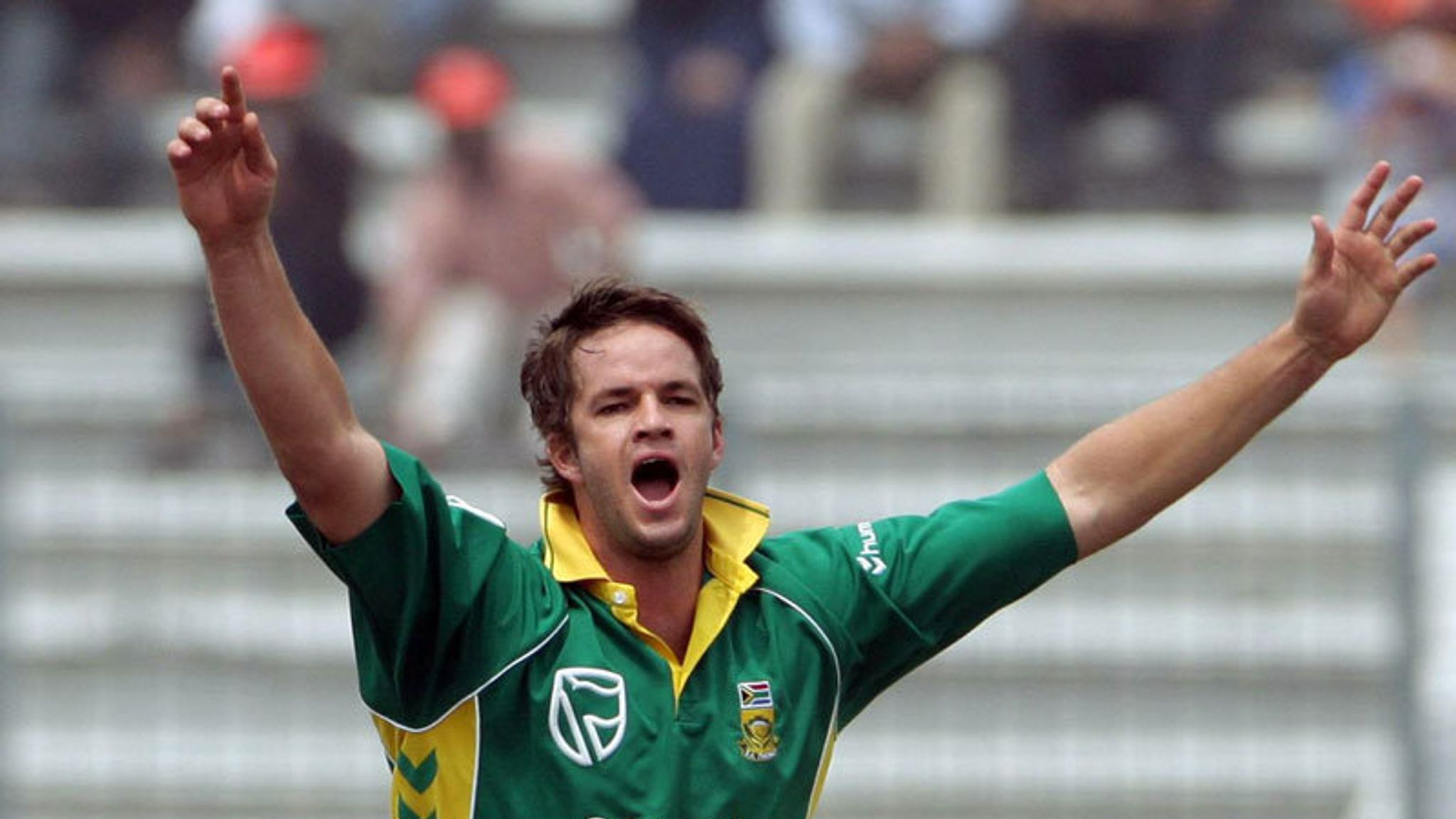
April 2012. Chennai. The target is 206. Chennai Super Kings are in trouble, wickets down, the asking rate climbing past what most teams would consider reasonable. Royal Challengers Bangalore look to have done enough. And then Albie Morkel walks to the crease.
What follows is not supposed to happen. Twenty-eight runs off a single Virat Kohli over. The game, seemingly gone, dragged back from the edge by sheer nerve and a left-handed swing that no bowler in world cricket had yet worked out how to stop. Chennai win.
The crowd loses its mind. And somewhere in that moment is the clearest possible summary of who Albie Morkel was as a cricketer — a man who arrived when things were hardest and made them look easy.
He turns 45 today, born 10 June 1981 in Vereeniging, Transvaal. And the story, it turns out, was only just getting started.
ROOTS: A FAMILY BUILT ON CRICKET AND CONCRETE
Vereeniging is not the kind of place that appears on cricket’s romantic map. It is an industrial town, hard-edged, built on steel and the legacy of a peace treaty that ended a war. It is not Newlands. It is not the lush KwaZulu-Natal midlands. But the Morkel family did not need picturesque surroundings to produce cricketers. They needed each other, a backyard, and a ball.
Albie was born the second of three sons to Albert and Mariana Morkel. His father Albert played provincial cricket. His older brother Malan played cricket. His younger brother Morné would go on to become one of the most feared fast bowlers South Africa has ever produced.
Cricket in the Morkel household was not a pastime — it was the primary language. Albie has spoken of childhood photographs in which a bat or ball is almost always somewhere in the frame. The game was simply always there, always present, always the thing around which everything else organised itself.
He attended Afrikaanse Hoër Seunskool in Pretoria, a school with serious sporting pedigree, and by the time he left it was already clear that he possessed something unusual. Not just batting. Not just bowling. Both — simultaneously, naturally, without apparent effort. That combination would define his career and, in some ways, complicate it.
THE EARLY CAREER: TOO GOOD TO IGNORE, TOO VERSATILE TO PIN DOWN
His first-class debut came for Easterns in the 1999/2000 season, and he wasted no time making his presence felt. A six-wicket haul against Griqualand West announced him as a bowler of genuine threat. The Klusener comparisons arrived almost immediately — Lance Klusener, South Africa’s great nineties allrounder, the man who could win games with either discipline. For a teenager, it was a heavy inheritance to be handed. Morkel carried it.
The moment that truly announced him came in 2003/04, playing against the touring West Indians at Benoni. Morkel was sick — properly sick, battling food poisoning throughout — and yet he scored a century and took five wickets in the same match. There are performances that reveal character more than ability, and this was one of them. It told anyone watching that here was a cricketer who did not use conditions, or circumstances, or discomfort as an excuse.
His ODI debut followed on 20 February 2004 against New Zealand in Bloemfontein. The early returns at international level were modest. The domestic game, however, kept rewarding him — including a 204 not out against Western Province Boland in 2004/05, a double century that confirmed the batting was not just big hitting, but something with genuine substance and range behind it.
THE SACRIFICE: ELEVEN YEARS, ONE TEST CAP
Here is the honest accounting of Albie Morkel’s international career: one Test, 58 ODIs, 50 T20 Internationals across eleven years. For a player of his talent, that is a number that deserves to sit with the reader for a moment.
He was good enough. Every coach who worked with him knew it. Every opposing captain who faced him knew it. The South African team of that era was simply so deep in allround talent that a settled berth was almost impossible to hold. Morkel was called up, left out, called back, and left out again.
He was selected for the 2005 Afro-Asia Cup squad and withdrew injured. He made three World T20 squads but never fully secured the international career his domestic performances demanded. By 2010 he was dropped from the national side for the tour of the West Indies.
His single Test cap came almost by accident — Morné was injured, Albie was called in as replacement for the third Test against Australia in March 2009, and responded with 58 runs and the wicket of Ricky Ponting. One cap. One innings. The door did not open again.
What makes this chapter of the story remarkable is not the disappointment — it is what Morkel did with it. He did not diminish. He did not disappear. He found a bigger stage elsewhere and proceeded to own it.
THE BREAKTHROUGH: DOWN UNDER, 2009
South Africa had never won an ODI series in Australia. That changed in the summer of 2008/09, and Albie Morkel was at the heart of why.
The series finished four-one to South Africa, a landmark result, and Morkel took two Player of the Match awards across the five games — destroying Australia with bat and ball in the precise, unhurried way that distinguished him at his best. At the end of the series he was named Player of the Series, the standout performer in a historic team achievement.
It was the international breakthrough his career had been building toward. It came relatively late, in his mid-twenties, after years of in-and-out selection. But when the moment arrived, he was ready for it — and the performance he delivered in that Australian summer remains one of the most complete allround series displays a South African has produced on foreign soil.
THE PINNACLE: YELLOW JERSEY, THREE TROPHIES, AND A LEGACY BUILT ON HIS OWN TERMS
The IPL did not just extend Albie Morkel’s career. In many ways, it gave him the stage his talent had always deserved.
Chennai Super Kings paid $675,000 for him at the inaugural 2008 auction, and from his very first season he looked like a player built specifically for this format. Two hundred and forty-one runs and 17 wickets in that debut campaign. Back-to-back IPL titles in 2010 and 2011, with Morkel a central rather than peripheral figure in both. His 91 wickets for the franchise made him CSK’s third-highest wicket-taker of all time.
CSK’s own farewell tribute when he eventually left said it plainly — the last-over smashes and the early wickets would all-be missed. The wordplay was affectionate. The sentiment was genuine.
But the chapter that deserves equal billing — and rarely gets it — is what he built with the Titans in the final years of his playing career. Appointed limited-overs captain from the 2015/16 season, Morkel led the Titans to three consecutive domestic T20 titles. Three seasons. Three trophies. A hat-trick of championships that required not just individual brilliance but the kind of sustained leadership that turns a good side into a dominant one.
His Titans coach at the time noted that Morkel had become driven to leave a legacy for younger players. That is exactly what he did.
He retired from all cricket in January 2019, nearly twenty years after his domestic debut. The farewell was warm, the record remarkable, and the man himself was already thinking about what came next.
FROM PLAYER TO COACH: BUILDING SOMETHING THAT LASTS
The first move in retirement told you everything. Rather than walk straight into a high-profile franchise role, Morkel signed with Namibia as coaching consultant. A developing nation. A programme that needed building from the ground up. An unglamorous starting point for a man who had played in IPL finals and won series in Australia.
It was the right call. Working alongside head coach Pierre de Bruyn, Morkel helped transform Namibian cricket into something the country had never experienced before.
When Namibia qualified for their first-ever T20 World Cup and progressed to the Super 12 stage, Morkel described it simply — cricket had been a dying sport in Namibia, but people had started watching again. That is not a small achievement. That is a coaching contribution that will outlast any trophy.
From Namibia, the path led back to familiar territory — the Titans, then Chennai Super Kings, then Joburg Super Kings — before Morkel was brought into the South African national setup under head coach Shukri Conrad as a specialist coaching consultant.
He is now part of the Proteas support staff at the 2026 T20 World Cup, and already being spoken of as a future head coach in the shortest format. His philosophy has been hard-won: coaching is not about absorbing pressure, it is about deflecting it.
Not intervening technically mid-tournament. Trusting players to be what they already are. Learning from the best — Stephen Fleming’s seventeen-year tenure at the Super Kings gave Morkel a front-row education in what genuine, lasting franchise excellence looks like.
The match-winner has become the master coach. The man who once hit 28 off a single over to win an IPL game is now the man standing at the boundary, quietly making sure the next generation knows how to do the same.
Happy 45th Birthday, Albie. From all of us at Just Plain Sport — you were always ahead of your time, and the game is better for the fact that you never left it. 🎂🏏