

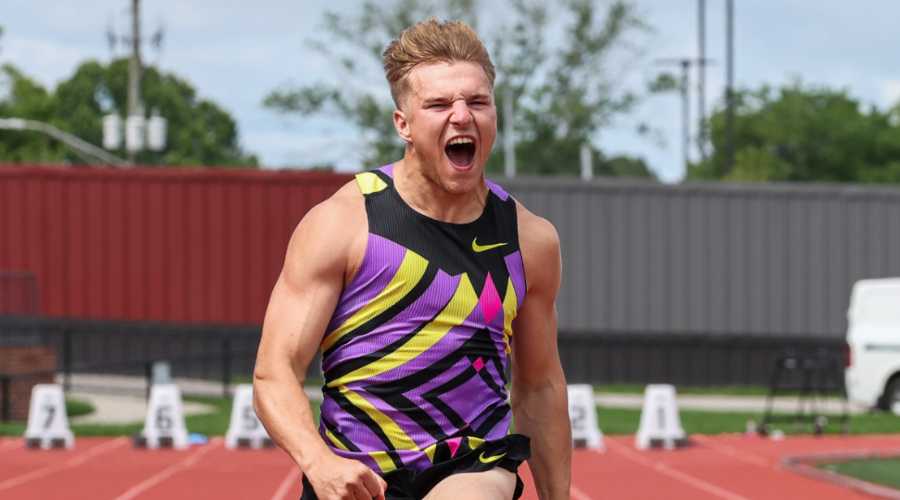
Three weeks ago, Sam Blaskowski’s name sat on a results sheet nobody bothered reading. Five meets into his 2026 season, three of them at altitude, he hadn’t touched his personal best once.
He hadn’t finished higher than third in any of them. If you’d told the track world he was about to become the second fastest man alive this season, they’d have laughed you out of the room.
That’s the strange thing about Blaskowski’s career so far. Nobody was watching, and somehow that’s exactly how it kept working out for him.
The pattern goes back further than this season. Coming out of high school in Oshkosh, Wisconsin, he didn’t receive a single Division One offer, not from anywhere, despite running times that should have at least started a conversation.
So he went to the University of Wisconsin-La Crosse instead, a Division III school where his parents had studied decades earlier and where his grandparents still live a mile from the stadium.
Division III doesn’t hand out athletic scholarships. It’s generally where promising careers quietly stall, not where they take off.
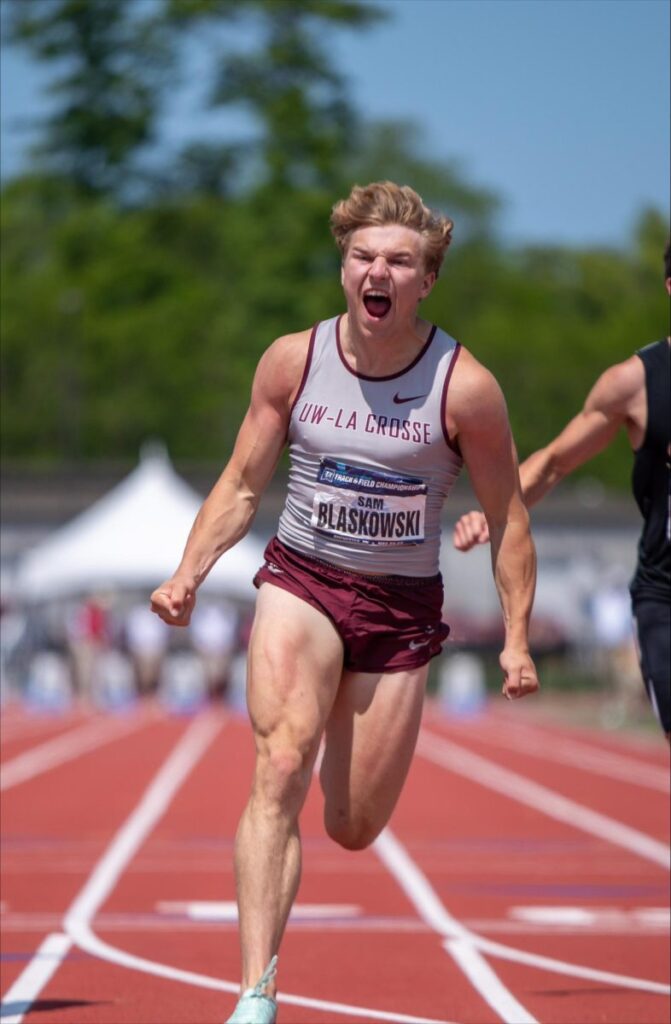
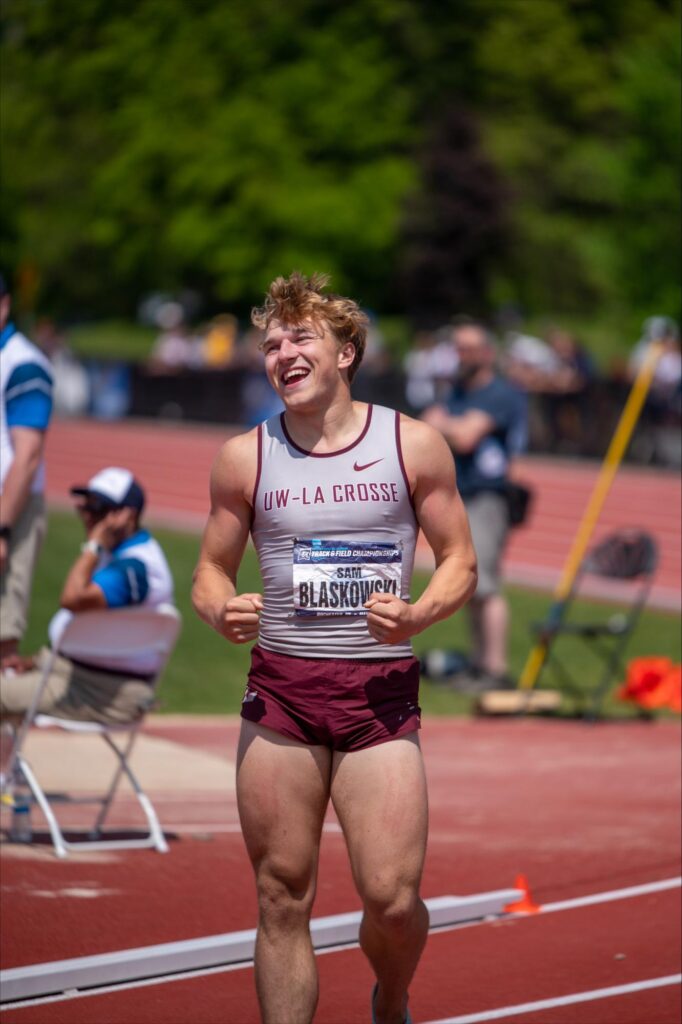
Sam Blaskowski went there anyway and won eleven individual national titles, setting Division III records in both the 60m and 100m along the way. His 10.05 in the 100 made him one of the most decorated sprinters that level of American college athletics has ever produced.
Even with all of that on his résumé, almost nobody outside Wisconsin had heard his name.
JAY | JPS SAYS: “I love stories like this because they’re a reminder that the sport doesn’t always tell you where to look. Nobody scouted this kid, nobody backed him early, and he just kept showing up anyway. That’s the stuff that actually means something.”
Getting from a school that can’t pay you a cent to a professional training group in Florida takes money, and Sam Blaskowski didn’t have a sponsor lining that up for him. He spent his off-season working shifts at a small regional airport, saving what he could toward the move south.
While the athletes he’d soon be training alongside were flying between Diamond League meets, Sam was behind a counter at a regional airport, quietly working toward something nobody else could see coming.
That saved-up money eventually got him to Star Athletics in Florida, training under coach Dennis Mitchell alongside Kenny Bednarek, Melissa Jefferson-Wooden and Sha’Carri Richardson. His first season with the group produced exactly nothing through five meets, the same five meets that opened this article.
Then came the Music City Track Carnival in Cleveland, Tennessee. Running out of lane four, Sam Blaskowski and Cameron Crump in lane five separated themselves from the field from the gun.
By 60 metres it was obvious Sam Blaskowski was losing speed slower than anyone else on the track. He crossed the line in 9.89 seconds, wind-legal, skipping the entire 9.90s bracket on his way to a personal best by 0.16 seconds.
Crump took second in 9.99 and Hicklin third in 10.05, which means Blaskowski’s winning margin of 0.10 seconds came against a genuinely stacked field. The run made him the fastest American in the world this year and tied him for second on the 2026 global rankings.
“Breaking 10 wasn’t just the goal, it became an obsession,” Blaskowski wrote afterward. “Years of sacrifice, hard work, discipline and belief all came together on the track.”
Within hours, social media had crowned him the fastest white man in history, unofficially overtaking France’s Christophe Lemaitre, who ran 9.92 back in 2011. The label spread fast and followed him through the week.
But it’s not the part of the story Blaskowski seems interested in. What he keeps coming back to is simpler: he’s number two in the world this season, full stop.
That context lands differently once you consider who he’s training with. Bednarek is a two-time Olympic 200m silver medallist with a 9.79 to his name, and Jefferson-Wooden and Richardson are among the most decorated sprinters on the planet.
A year ago Blaskowski was working an airport counter to afford the flight down. Now he shares a track with all three of them, and the gap between his times and theirs is shrinking fast.
None of this reads like a finished story. A sprinter who went from zero Division One interest to 9.89 in a single race, during a season already affected by altitude meets and a winless streak, still has plenty of room to move.
Blaskowski himself has been candid about what that climb actually costs. “Every day you go through these mental battles, how do I keep going?” he said. “You’re in a sport where you don’t just leave college and start making a million dollars.”
That’s the part that never shows up on a results sheet. Five meets of nothing, an off-season spent clocking in at a regional airport, a college career most of the sport never noticed, and then one Saturday in Tennessee where all of it suddenly clicked.
Nobody was watching Sam Blaskowski. After 9.89, that’s no longer an option.
📸 via Sam Blaskowski