



Fireworks lit up Loftus Versfeld. A special commemorative ball was handed over. And in the 12th minute, Willie le Roux did what he has always done — he found space where there was none and strolled over the tryline, making his 400th first-class appearance one to remember.
Saturday, 16 May 2026 was a landmark day in South African rugby. The Vodacom Bulls hosted Benetton in the final round of the URC league stage, but the occasion was always going to be about more than the result.
It was about a man who started his career in Boland club rugby — driving from Wellington to Montagu on Saturdays for a game, sometimes getting nothing more than petrol money and a couple of brandies after the final whistle — and who has never stopped proving people wrong. The Bulls won comfortably, 45–19, securing a home quarter-final in the process.
A Career Built from the Ground Up
Willie le Roux’s story is not the story of a hotshot academy prospect picked up straight out of school. He was passed over for a contract after his schoolboy career at Paul Roos — the Western Province Academy showed no interest. He funded his own way through the Boland Academy, played club rugby on wet, soggy fields at Hamiltons for Maties on Friday nights, and waited patiently for the world to notice.
It took 39 Boland caps before someone did. A move to Griquas followed, where he reinvented himself as a wing and quickly became a household name. Just 11 caps later, he earned a Springbok call-up from coach Heyneke Meyer — by which point he was already contracted at Griquas and, as he jokes, probably earned more in his first few Bok games than his entire Griquas salary.
“I played Boland club rugby, driving from Wellington to Montagu on a Saturday. If you were lucky you received petrol money and perhaps two brandies after the game. I came through all of that and it shaped me.” — Willie le Roux
The Clubs, the Countries, the Caps
His 400 games span a genuinely global career — a rugby life lived across multiple hemispheres and jerseys.
It started at Boland and Griquas, where the foundations were laid in obscurity and determination. From there he moved to the Cheetahs, spending 58 appearances in the famous orange jersey and cementing his reputation as one of the most inventive backs in the country. A move to Wasps in England brought 61 caps alongside Danny Cipriani and Kurtley Beale — a trio of mavericks that delighted rugby fans across two hemispheres.
Japan followed, with 61 games for Toyota Verblitz and Canon Eagles in a stint that broadened his game and extended his career well beyond what doubters had predicted. A return to South Africa saw 13 caps for the Sharks before the Bulls secured his services, where he has now made 55 appearances in blue and white.
Running through all of it: 101 Test caps for the Springboks, a bronze medal at the 2015 Rugby World Cup, and winner’s medals at both 2019 and 2023. As decorated as it gets.
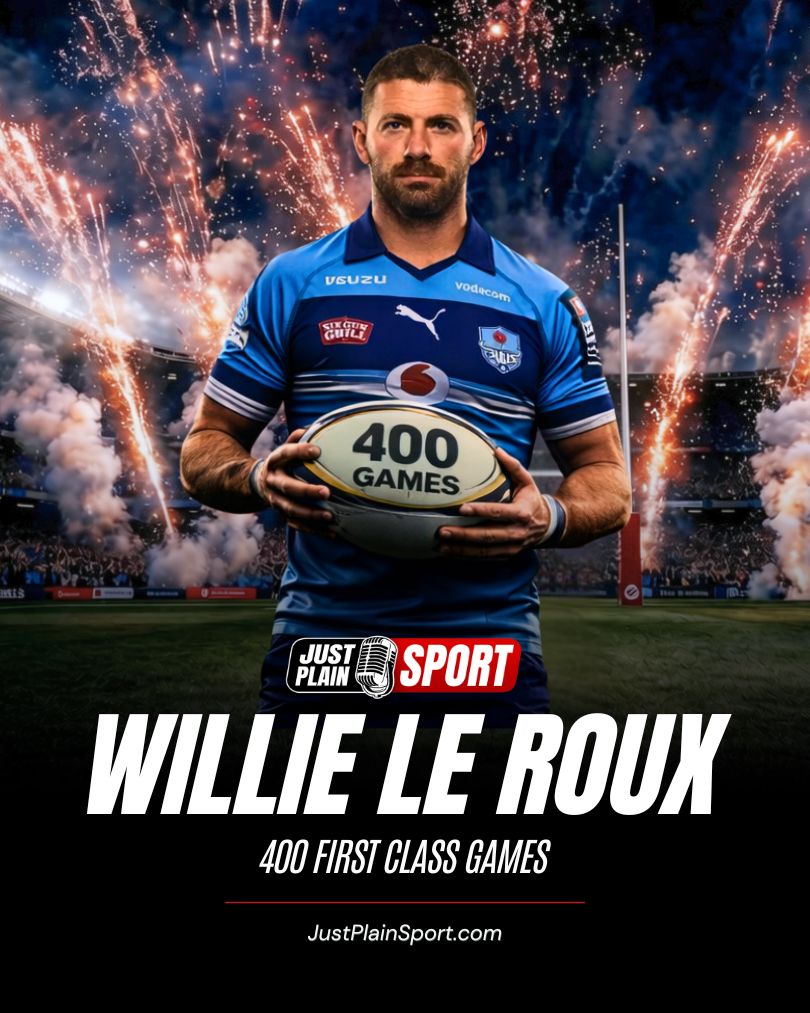
Still Delivering at 36
What makes Saturday’s milestone even more remarkable is that this was not a ceremonial appearance. Le Roux was rated 8 out of 10 by analysts on the day — sharp with ball in hand, breaking the line twice, and providing the sublime handling that set up Sergeal Petersen’s second try. Handré Pollard simply sent him through untouched for his own score and he waltzed over. Business as usual.
In the days before the match, he thanked the various unions he has represented throughout his career — starting with Boland — in a conversation with SuperSport. It was a moment that revealed exactly the kind of person he is: deeply grateful, grounded, and acutely aware that none of this happened by accident. People gave him chances. He repaid every one of them.
“It still feels like I have to prove myself. It still feels like I’ve got a point to prove. You always feel you have that chip on your shoulder — whether you have one test or 50 or 100.” — Willie le Roux
The Critics, the Haters, the Doubters
Le Roux has never had universal approval. There have always been those who would rather spotlight the one trick that didn’t come off than appreciate the ten moments of brilliance that preceded it. The calls to play someone younger have followed him for years. He has heard them all — and kept playing.
What his harshest critics miss is what every coach he has ever worked under understood immediately: Willie le Roux makes the players around him better. He unlocks defences. He finds angles that others don’t see. He has the rugby brain of a chess grandmaster in the body of an athlete who still plays like he has something to prove.
Coach Rassie Erasmus once told him: if they don’t say anything, then you should be worried. If they talk — good or bad — they are interested. It is a piece of advice that fits le Roux perfectly. He has never been out of the conversation.
THE GOAT of the SA Fullback Conversation?
South Africa has produced world-class fullbacks throughout its rugby history. But the case for Willie le Roux being the greatest — or at least the most uniquely gifted — is a strong one. Two World Cup winner’s medals. 101 Test caps. A playing style that has never been replicated. A career that has stretched across four decades, four countries, and now 400 first-class games.
He has no intention of stopping. He has spoken about playing until he is 40, citing Ruan Pienaar, Morne Steyn, and Ma’a Nonu as inspiration. Given what he has shown this season — starting at flyhalf when Pollard needed rest, still breaking the line at will — there is absolutely no reason to doubt him.
The fireworks at Loftus on Saturday were fitting. Willie le Roux has lit up rugby fields for twenty years. With any luck, he has a few more years left to dazzle us yet.