


He grew up in Despatch, a small working-class town in the Eastern Cape, far removed from the boardrooms and broadcast studios where rugby legends are usually made…
This week, Johan “Rassie” Erasmus stood at the very top of South African public life, receiving the National Order of Ikhamanga in Gold from the South African Presidency — the country’s highest honour for sporting excellence.
It is an award reserved not just for winners, but for those who have changed something. And what Rassie changed, arguably, was South Africa’s relationship with itself.
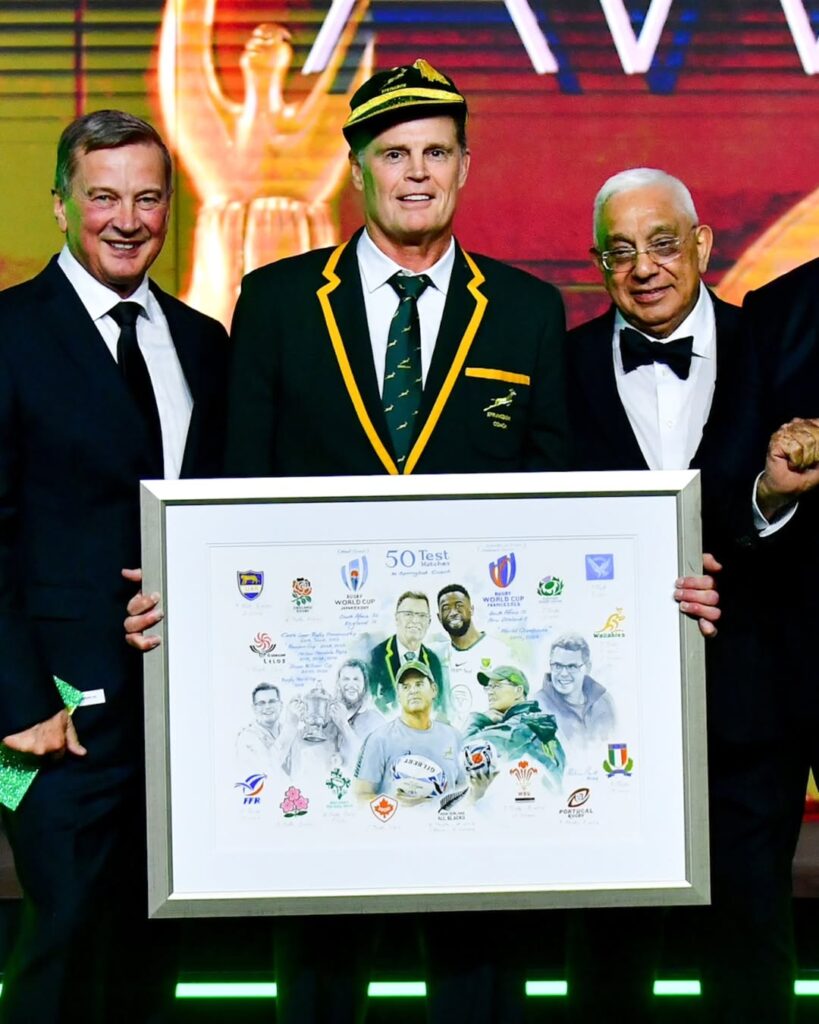
The Presidency’s own nomination said it plainly: Erasmus deserved the recognition for his “inspirational leadership in national and international rugby that has propelled the Springboks to repeated Rugby World Cup championships.” They went further, noting that “victory on the field of play has advanced social cohesion among South Africans and raised the nation’s esteem in the international community.”
That is a remarkable thing to say about a rugby coach. It is also completely accurate.
Back-to-back World Cup titles in 2019 and 2023 would be enough on their own to secure his legacy. But the story of how those titles were won — and what they meant to a fractured nation still navigating its own identity — is what elevates Rassie Erasmus from great coach to genuine national figure.
The 2019 campaign alone was the stuff of legend.
The Springboks dismantled England 32–12 in the final in Japan, in one of the most dominant World Cup final performances the sport has ever seen. Erasmus was named World Rugby Coach of the Year that same year. The Springboks also claimed the Rugby Championship, reasserting their dominance in the southern hemisphere.
Then came 2023. Back-to-back. Done.
No other coach in the professional era has delivered consecutive World Cup titles. The numbers back it up — Erasmus has maintained a winning rate of nearly 74% as Springbok head coach, the sixth-best in the team’s history, and holds the record for the most Rugby Championship wins of any Springbok coach.
These are not soft statistics. These are all-time numbers.
“Rassie didn’t just build a winning team — he built a team South Africa needed. In a country filled with division and corruption, he gave us a Springbok jersey we could all wear with pride, regardless of where we come from.” – Jay | JPS
What makes this story richer is what Erasmus was carrying privately during those years of public triumph. In 2019, as he was preparing the Springboks for their World Cup campaign in Japan, he was quietly managing a serious autoimmune condition — a diagnosis he chose to keep personal rather than use as narrative. That is not the behaviour of someone chasing headlines. That is the behaviour of a leader.
He has described himself as “a quiet, uncomplicated person.” Anyone who has watched him work would tell you the outcomes have been anything but quiet.
His roots matter here too. Erasmus grew up the son of a father who battled addiction, in a town that does not produce many global icons. He built his coaching career from the ground up, winning Currie Cup titles with the Free State Cheetahs — including their first title since 1976 — before ascending to the highest levels of the game. There was no shortcut. There was no safety net.
North-West University recognised the full scope of his contribution in 2024, awarding him an Honorary Doctorate for his innovative management of the Springboks and his commitment to social responsibility. That same year, his induction into the RugbyPass Hall of Fame in 2021 had already cemented his place among the sport’s immortals.
The National Order of Ikhamanga in Gold, however, sits above all of it. It is South Africa’s ultimate statement — a declaration that this person’s contribution went beyond sport, beyond statistics, beyond winning.
SA Rugby President Mark Alexander framed it with precision: “Rassie’s achievements have united South Africans across communities, instilling pride and inspiring a spirit of togetherness through the game we love. His leadership and vision have left an indelible mark on the sport and on our nation. Rassie Erasmus is a true son of the South African soil.”
That phrase — son of the soil — carries enormous weight in South Africa. It speaks to authenticity, to earned belonging, to a story that did not begin in privilege. Rassie Erasmus earned every syllable of it.
South Africa is a country that has known division in ways that cut deep and last long. Rugby has not always been a sport that belonged to everyone. Under Erasmus, something shifted. The Springboks became a team that transcended race and language and background — a rare thing in South African public life, and a fragile thing that takes exceptional leadership to maintain.
When the Boks lifted the Webb Ellis Cup in 2019, the streets did not just celebrate a rugby victory. They celebrated something harder to define and more important — a shared moment of national pride in a country that does not always find those easily. When they did it again in 2023, South Africa was reminded that it was not a fluke. It was a standard.
That is the legacy the Order of Ikhamanga in Gold is recognising. Not just the trophies on the shelf, but the belief Rassie Erasmus put back into a nation that sometimes struggles to believe in itself.
Congratulations, Rassie. Enkosi. Baie dankie. 🟢🟡
We’ll be tracking Rassie Erasmus and the Springboks all season. Follow JustPlainSport for the next chapter. 🔔
Image via SA Rugby