

Picture the young Siya Kolisi. He sleeps near the front door of his grandmother’s two-room house in Zwide township, Port Elizabeth, on a makeshift bed of sofa cushions wedged together so they don’t slide apart in the night.
The year is somewhere in the late 1990s. There are already five people in the house. His favourite toy is a brick he pushes through the streets. His parents are teenagers who cannot keep him. His country is only just learning what it might mean to be free.
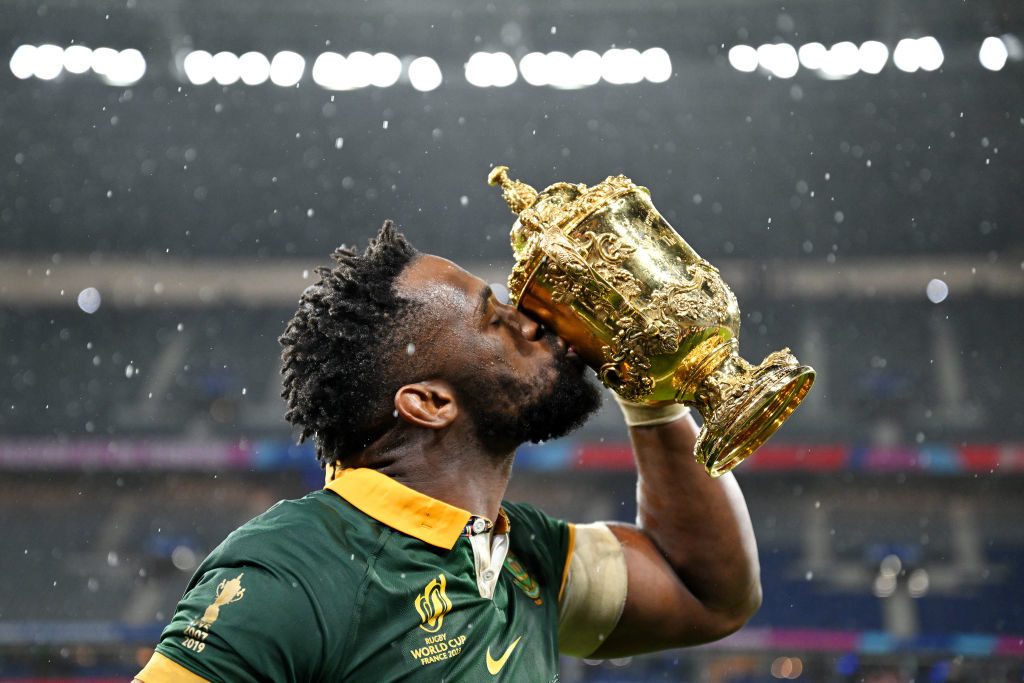
Now picture Siya Kolisi the man. Standing in the middle of the Stade de France in Paris on the night of 28 October 2023, wearing the green and gold. Holding the Webb Ellis Trophy aloft for the second time. Surrounded by a team that has just beaten New Zealand by one point to become the first nation in history to win four Rugby World Cups. The whole of South Africa — load-shedding, unemployment, hope and all — watching.
Siyamthanda Kolisi. Born on 16 June 1991 in Zwide, a township on the edge of what was then Port Elizabeth, in the Eastern Cape. He turns 35 today, on a date that, by a twist of history, marks exactly 15 years after the Soweto Youth Uprisings of 1976. South Africa writes itself into his story whether he asks it to or not.
Happy Birthday, Siya. You became the last line of defence for an entire nation, and you held the line.
ZWIDE: THE PLACE THAT MADE HIM
The Eastern Cape produces rugby players the way it produces hard weather — with little warning and in quantities that leave the rest of the country quietly astonished. But what it produces most reliably is men who know that nothing is given, that everything costs something, and that the community around you is either your salvation or your ruin.
Siya was born to Phakama, who was sixteen years old when he arrived, and Fezakele, who was still finishing school. His mother’s family could not afford to feed another mouth. His father’s mother, Nolulamile, took the infant in and raised him as her own. The cushion bed by the front door was not a hardship she complained about. It was simply what was. When his mother died — Siya was fifteen — his grandmother became everything. She is the person his success belongs to, even if the world will always attach it to him.
He played rugby from the age of seven, following older relatives onto whatever patch of ground was available. His junior club was the African Bombers, a name that carried its own particular swagger. What those early years gave him was not technical polish — it was something closer to instinct, the ability to read a game not from a coach’s whiteboard but from the street-level intelligence of a boy who had learned to read everything around him quickly. When you grow up where Siya grew up, slow reading costs you.
The turning point came at twelve, at a youth tournament in Mossel Bay. He was seen. A scholarship to Grey Junior School followed, and then to Grey High School, one of the most storied rugby institutions in the Eastern Cape. The boy from Zwide who slept on cushions by the door now walked the same corridors that had produced Graeme Pollock. He was not there to be grateful. He was there to work.
STORMERS: EARNING HIS PLACE
Grey High School gave Siya a pathway. His talent did the rest. He represented Eastern Province at Under-16 Grant Khomo Week and at Craven Week for the Under-18s, marking himself as a prospect serious enough to attract Western Province, who brought him into their system for the 2010 and 2011 seasons.
He made his senior debut for Western Province against the Golden Lions in the 2011 Vodacom Cup, and by the time the Currie Cup came around that year, a run of injuries and international call-ups had opened the door for regular starting opportunities. He made thirteen appearances, scored four tries, and showed the combination of physical aggression and on-field intelligence that would eventually define him.
The 2012 season brought a Super Rugby debut with the Stormers and a thumb injury that curtailed his year almost before it began. He watched his team win the Currie Cup from the side. He came back stronger.
By 2013, he had earned a place in the Springbok squad. On 15 June 2013 — the day before his twenty-second birthday, as it happened — he was called off the bench against Scotland in Nelspruit in the fourth minute of play, replacing an injured Arno Botha.
He was named Man of the Match in a 30-17 win. It was a debut that made a statement without needing to announce itself. He played again, and again, and kept playing. By 2015, he was in the World Cup squad in England, taking the field against Japan and Samoa. The tournament ended badly for South Africa. He filed it away.
The Stormers captaincy came in February 2017, awarded by coach Robbie Fleck with Eben Etzebeth serving as deputy. It was the first formal confirmation of what his teammates already knew: that Siya led not by pronouncement but by presence, not by telling people what to do but by doing it first and doing it better. That quality would be noticed at a level beyond club rugby very soon.
THE YEAR OF THE TORN KNEE
Before the story gets to its greatest chapters, it must stop twice for injury.
The first time was in May 2019, playing for the Stormers against the Highlanders. A knee injury. Surgery. The Rugby World Cup in Japan was four months away. He had just been confirmed as Springbok captain for the tournament. The medical consensus was not encouraging.
The second time was in April 2023, in a URC clash with Munster. He partially tore his anterior cruciate ligament attempting to step an opponent. The World Cup defence in France was less than five months away.
His wife Rachel implored her social media following to pray. His coaching staff said publicly that he was their captain regardless, that they would carry stand-ins until he was fit or was not. What followed, both times, was what Kolisi described simply as a foundation.
“My foundation was in God,” he said after the 2023 recovery. “If I didn’t know something, I prayed about it.”
The medical team were, by their own account, surprised. “There was no way I could justify or explain how I was healing so quickly,” he said. “Some of the medical team were saying it was not normal.” He played in the warm-up match against Wales in Cardiff in August 2023. He flew to France with the squad.
He walked out for the final in Paris six months after surgeons had operated on his knee.
Faith is a private thing for most people. For Siya, it has always been the part of his story he refuses to edit out for an audience that might not want to hear it. “I don’t have a sangoma. I have a pastor. I pray, I pray,” he told a journalist who asked the question with a smile. He was not smiling when he answered.
THE CAPTAINCY: WHAT RASSIE GAVE HIM AND WHAT HE GAVE BACK
On 28 May 2018, Rassie Erasmus named Siya Kolisi as Springbok captain number 61 in the history of the team. It made him the first black player to captain South Africa in a Test match in the 126-year history of the Springboks.
The history of what that means — of who was kept out and who was let in and why and by whom and at what cost — is not the kind of history that fits into a birthday tribute. But it must be named, because to write about Siya Kolisi without it is to write about a building without its foundations.
Bryan Habana, who knew what it meant better than most, called it “a monumental moment for South African rugby, and a moment in South African history.” Kolisi himself was more honest about the weight of it. “It was difficult,” he said later.
“Being the first black captain — it was really difficult at the beginning because I don’t think there’s any greater honour other than playing for the Springboks. To captain a team like this, with its history and everything.” He had imagined many things for his life. He had not imagined this.
He led South Africa to a series win over England in June 2018. In September, he captained them to a 36-34 victory over the All Blacks in Wellington, the Boks’ first win in New Zealand since 2009. The team that had arrived in disarray was being rebuilt game by game, and the captain was both the symbol of that rebuilding and one of its engines.
YOKOHAMA AND PARIS: THE TROPHIES THEY SAID WEREN’T COMING
The 2019 Rugby World Cup final was played on 2 November in Yokohama. South Africa beat England 32-12. Kolisi lifted the Webb Ellis Trophy. He was the third Springbok captain ever to do so, following Francois Pienaar in 1995 and John Smit in 2007. He was the first black captain anywhere in the world to lift the trophy.
After the match, in his press conference, he said: “We can’t do anything about the past, but we can do something about the future. We can be an example and inspiration to the people back home.” It was not the kind of thing coaches script for players to say. It was the kind of thing that comes out when a man is telling the truth about what he has been carrying.
The 2023 defence was improbable in a different way. South Africa entered France having beaten New Zealand by a record 35-7 at Twickenham in a warm-up match. Expectations had shifted; the Boks were no longer underdogs. They won three consecutive knockout matches by a single point each — against France in the quarter-final, England in the semi-final, and New Zealand 12-11 in the final at the Stade de France.
Their hooker went off injured early. Kolisi was yellow-carded and spent ten minutes on the sideline watching his team hold on without him. New Zealand played most of the second half with fourteen men after Sam Cane received a red card. The match was chaos and grit and will.
“We are the last line of defence,” he told ITV Sport after the final whistle. “There is so much going wrong in our country. We may not be able to change their circumstances, but we can give them hope. We can inspire people.”
He had won two World Cups. He was thirty-two years old. He called himself a last line of defence.
GOING HOME: THE STORMERS AND WHAT REMAINS
The years since Paris have been marked by movement and by the private turbulences that run beneath public lives. In January 2023, Kolisi signed with Racing 92 in the French Top 14, one of the most demanding leagues in world rugby. He and Rachel relocated.
The contract was due to run until 2026. It ended after one season. He came home to the Sharks in 2024, citing the physical and logistical demands of French rugby alongside international duty.
In October 2024, he and Rachel announced their divorce after eight years of marriage. They had two children together, Nicholas and Keziah, and had raised Siya’s younger siblings, Liyema and Liphelo, as part of their family. The announcement was made jointly, warmly, and with evident pain.
“While our relationship as a couple is changing,” their statement read, “we remain great friends and committed partners in raising our children.” The Kolisi Foundation, which they co-founded in 2020 to address inequality in South Africa, continues its work.
In December 2025, Kolisi announced he would be leaving the Sharks at the end of the URC season to return to the Stormers — taking what the Stormers’ director of rugby John Dobson confirmed was a massive pay cut to do so. The reason was not complicated. His family is in Cape Town. His children are there.
“My family is in Cape Town and it is important to me to be close to them,” he said. “This move gives me the chance to do that while also giving back to the team and fans who made such a big contribution to the player and person I am today.”
He remains Springbok captain. The 2027 Rugby World Cup in Australia is on the horizon. He is thirty-five. The boy from Zwide is still going.
Happy 35th Birthday, Siya. From all of us at Just Plain Sport — you built your foundation in the hardest possible place, and you never once let it crack. 🎂🏉