


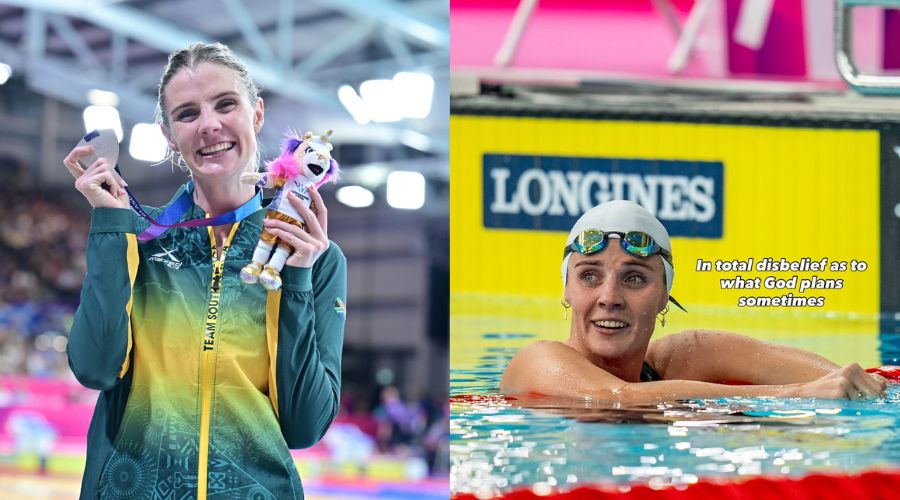
Two minutes, 22.97 seconds in Irvine, California. That is what the Kaylene Corbett Pan Pacs bronze looks like on the clock — third in the women’s 200m breaststroke on the closing night of the 2026 Pan Pacific Championships, four tenths behind the reigning Olympic and world champion, and 0.91 off a personal best she set five years ago in Tokyo.
Women’s 200m breaststroke final — 2026 Pan Pacific Championships, Irvine, 15 August:
- 🥇 Alexanne Lepage (CAN) — 2:21.73
- 🥈 Kate Douglass (USA) — 2:22.57
- 🥉 Kaylene Corbett (RSA) — 2:22.97
- 4. Ella Ramsay (AUS) — 2:23.53
- 5. Satomi Suzuki (JPN) — 2:24.06
- 6. Alex Walsh (USA) — 2:24.28
- 7. Kotomi Kato (JPN) — 2:24.40
- 8. Sophie Angus (CAN) — 2:26.02
Lepage took the race out and never handed it back, the 20-year-old Canadian sitting in front from the first turn and holding on for a lifetime best that cut roughly a second and a half off her previous mark. Behind her, the race was a scrap.
Corbett was in the silver position turning for home. Douglass, who had set a world record in the 50m freestyle earlier in the same session and collected her gold medal still wearing her cap before turning around to race again about twenty minutes later, was third at that point and coming.
The American closed in 36.93. Corbett closed in 37.39. That 0.46 of a second over the final length was the difference between silver and bronze, and Kaylene Corbett still finished more than half a second clear of Ramsay in fourth.
The number that matters is the one on her own scoreboard, though. Kaylene Corbett has been to two Olympic finals in this event and stood on three major championship podiums, and 2:22.97 is quicker than anything she produced on any of them.
Her World Championships bronze in Singapore last year came in 2:23.52, shared with Alina Zmushka. Her Commonwealth Games silver in Glasgow three weeks ago came in 2:24.46. This was the fastest of the three by more than half a second, swum at the end of a season that has already asked her for two full championship taper cycles.
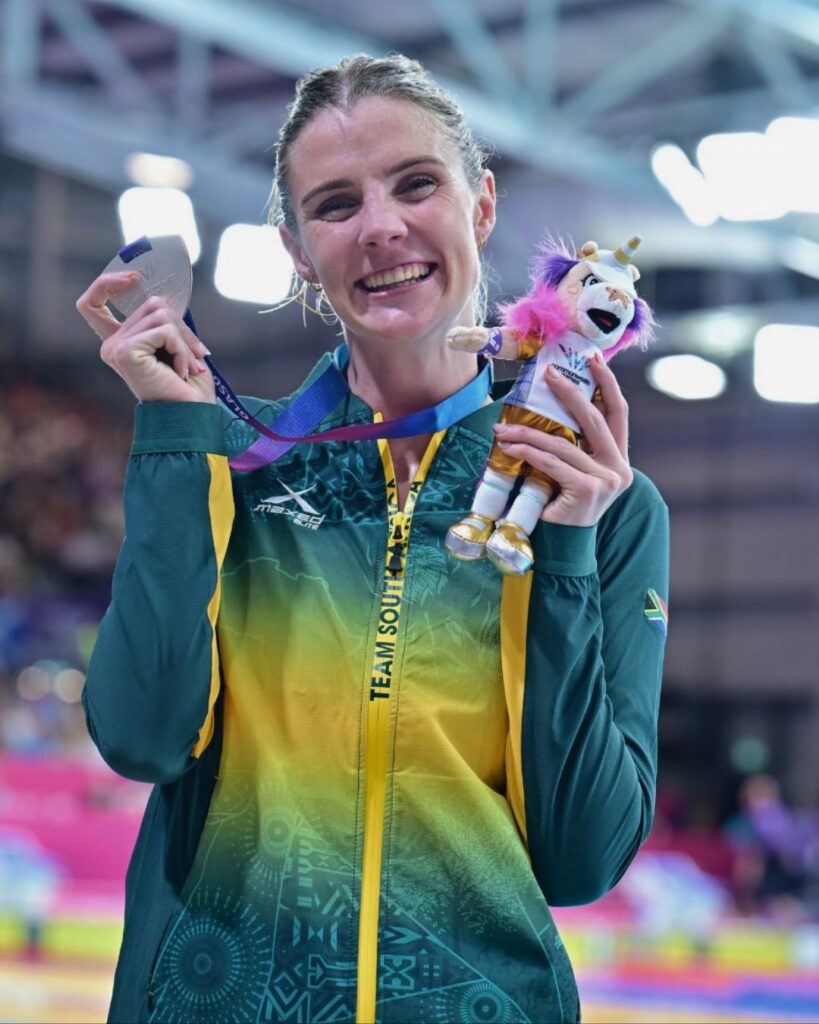
She had qualified third fastest that morning in 2:23.54, sitting behind Douglass in a heat where nobody needed to be trimmed by the two-per-country rule. She then took nearly six tenths off that in the final. Swimmers at the back end of a long season do not usually improve twice in one day.
The context behind all of this is the space that opened up when Tatjana Smith walked away. Smith retired immediately after Paris 2024 with gold and silver around her neck, and for most of Kaylene Corbett’s career she had been the other South African in the lane — the training partner at Tuks under Rocco Meiring, the one who made the final while somebody else made the headline.
That was the framing after Tokyo, when Kaylene Corbett swam a personal best of 2:22.06 for fifth in the same final where Smith broke the world record. It was the framing again in Birmingham in 2022, when Corbett took bronze in a final Smith won.
Singapore changed it. Kaylene Corbett’s bronze there was her first medal at a global championships, her country’s only women’s medal of the meet, and it earned her both the Swammy and the Swimming World award for African Female Swimmer of the Year.
“Corbett has spent a decade being the other name in the lane, and she has now medalled at three straight major championships. Nobody hands you that!” – 🎙️Jay
What has followed since is a run that deserves to be read as a whole rather than as three separate results. World Championships bronze in August 2025. Commonwealth Games silver in July 2026. Pan Pacific Championships bronze in August 2026, three weeks after Glasgow, on the other side of the world, against a field carrying the Olympic champion and a Canadian in the form of her life.
She turned 27 in June. In a discipline where the 200m breaststroke medal table at the last two Olympics has been dominated by swimmers in their mid-twenties and older, that is not a wall — it is the working range.
The Kaylene Corbett Pan Pacs bronze also gave South Africa its second medal of the meet. Michael Houlie took silver in the 50m breaststroke in 26.42, dead-level with American Van Mathias and behind Sam Williamson’s championship-record 26.36, after Houlie had set a Pan Pacific Championships record of 26.40 in the prelims that morning.
Erin Gallagher was fifth in the 50m butterfly in 25.43 and sixth in the 100m butterfly in 57.24, in a butterfly field led by Gretchen Walsh, who broke the championship record in both events. Morgan Cope made the 50m breaststroke final and finished eighth.
For a South African contingent this size at an invitational meet built around the United States, Australia, Canada and Japan — a meet where the hosts alone took 50 medals — two podium finishes is a real return.
The wider point is what Irvine says about the next two years. The 200m breaststroke is not getting slower. Lepage’s 2:21.73 came from a swimmer who was seeded fifth in the morning. Douglass owns a 2:18.50. Evgeniia Chikunova, the world record holder at 2:17.55, was not even in this pool.
Kaylene Corbett has now spent thirteen months turning up in that company and going home with something every single time, and she is doing it at a stage of her career when the sensible prediction would have been a slow drift out of finals. Los Angeles 2028 is two years away, in the same country and the same time zone as the swim she just produced.
There is nothing sentimental in any of this. The 2:22.97 is a hard number, posted in a hard race, against the two swimmers who finished ahead of her and five who did not.
📸 Images via Kaylene Corbett IG / Team SA